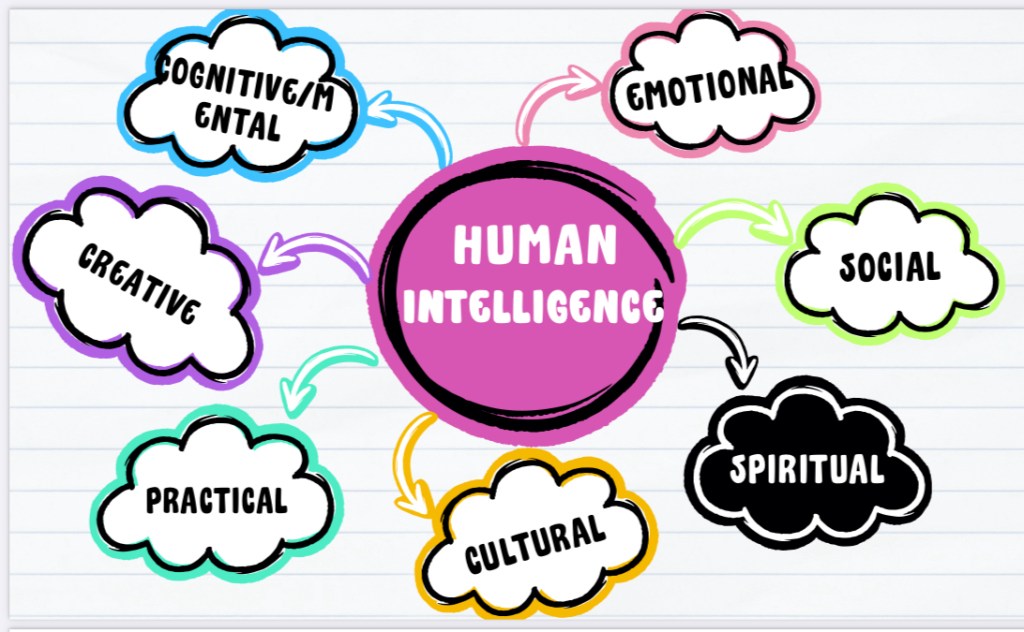
Human Intelligence is a multifaceted concept that has intrigued philosophers, scientists, and thinkers for centuries. It encompasses a wide array of abilities, skills, and traits that contribute to an individual’s capacity to understand, learn, and adapt to their environment. From problem-solving and critical thinking to emotional intelligence and creativity, human intelligence manifests in various forms and plays a crucial role in shaping human behavior and society as a whole.
Intelligence, at its core, refers to the ability to acquire and apply knowledge effectively. This includes not only the capacity to learn new information but also the aptitude to analyze, synthesize, and utilize that knowledge in practical ways.
Intelligence enables individuals to make informed decisions, solve complex problems, and navigate the challenges of everyday life with confidence and competence. It is noteworthy that human intelligence acquired can be positively or negatively applied to circumstances, environments, and other people.
One of the most commonly recognized forms of intelligence is cognitive intelligence, often measured by standardized tests such as IQ tests. Take yours here.
Cognitive intelligence encompasses abilities such as logical reasoning, mathematical proficiency, verbal comprehension, and spatial awareness. It reflects a person’s capacity for abstract thinking and problem-solving and is often associated with academic success and intellectual achievement.
However, intelligence extends far beyond cognitive abilities alone.
Emotional intelligence, for example, plays a significant role in interpersonal relationships, self-awareness, and personal well-being. Emotional intelligence encompasses skills such as empathy, self-regulation, social awareness, and relationship management. Individuals with high emotional intelligence can understand and manage their own emotions effectively while also navigating social dynamics and communicating empathetically with others. Test your EI here.


Creativity is another essential aspect of intelligence often overlooked in traditional measures of cognitive ability. Creative intelligence involves the capacity to generate novel ideas, solutions, and perspectives. It encompasses imagination, originality, and the ability to think outside the box. Creative individuals can approach problems from unconventional angles, innovate in various domains, and inspire others with their imaginative visions. Find out your Creativity level here.

Furthermore, practical intelligence, sometimes referred to as “street smarts,” is crucial for navigating real-world situations and everyday challenges. Practical intelligence involves skills such as adaptability, resourcefulness, and common sense. It enables individuals to apply their knowledge and abilities effectively in different contexts, whether at work, in relationships, or during unexpected circumstances. Test your PI here.

Cultural intelligence is another dimension of intelligence that has gained recognition in recent years. Cultural intelligence refers to the ability to interact effectively with people from different cultural backgrounds and adapt to diverse social norms, values, and communication styles. In an increasingly interconnected world, cultural intelligence is essential for fostering cross-cultural understanding, collaboration, and cooperation. How is your cultural intelligence? Click here to test and find out.
Spiritual intelligence is a concept that delves into the realm of human consciousness and explores the deeper dimensions of existence beyond the physical and material aspects of life. It encompasses the capacity to connect with a higher power or transcendent reality, as well as to seek meaning, purpose, and wisdom in life’s experiences. Testing your SI will depend on the spirituality you align with as they are not all the same as regards the connector, though all claim to point to the same highest order.

It’s important to recognize that intelligence is not fixed or static but rather dynamic and malleable. While some aspects of intelligence may be influenced by genetic factors, environmental factors, such as education, upbringing, and life experiences, also play a significant role in shaping intelligence. Moreover, intelligence can be cultivated and enhanced through deliberate practice, lifelong learning, and exposure to new ideas and experiences.

Finally, Social Intelligence refers to the ability to understand and navigate social situations effectively. It involves skills such as empathy, interpersonal communication, understanding social cues, and building relationships. Social intelligence is essential for success in personal and professional relationships. Test your social intelligence here.
Concept of multiple intelligences by psychologist Howard Gardner
The concept of multiple intelligences, proposed by psychologist Howard Gardner, challenges the notion of a single, unitary form of intelligence. Gardner identified several distinct types of intelligence, including linguistic intelligence, logical-mathematical intelligence, spatial intelligence, musical intelligence, bodily-kinesthetic intelligence, interpersonal intelligence, and intrapersonal intelligence. According to this theory, individuals may excel in different domains of intelligence, each contributing to their overall cognitive profile.
From a neurological perspective, intelligence is associated with the functioning of the brain and its complex neural networks. Advances in neuroscience have shed light on the neural mechanisms underlying various aspects of intelligence, including memory, attention, perception, and executive function.
Studies have shown that intelligence is influenced by a combination of genetic and environmental factors.
Research suggests that intelligence is not localized to a single brain region but rather involves coordinated activity across multiple regions of the brain.
Moreover, studies have shown that intelligence is influenced by a combination of genetic and environmental factors. While genetic factors contribute to the baseline level of intelligence, environmental factors, such as education, socioeconomic status, and opportunities for enrichment, can significantly impact cognitive development and intellectual achievement. Early childhood experiences, in particular, play a crucial role in shaping cognitive abilities and laying the foundation for lifelong learning and intellectual growth.
Final thoughts
Human intelligence is a complex and multifaceted phenomenon that encompasses a broad range of abilities, skills, and traits. There are various dimensions to human intelligence, each contributing to an individual’s capacity to understand, learn, and adapt to their environment. While intelligence may have a genetic basis, it is also influenced by environmental factors and can be cultivated through education, experience, and deliberate practice. Understanding the nature of intelligence is essential for fostering intellectual development, promoting lifelong learning, and enhancing human potential in all its diversity and richness.
 Think-Talk