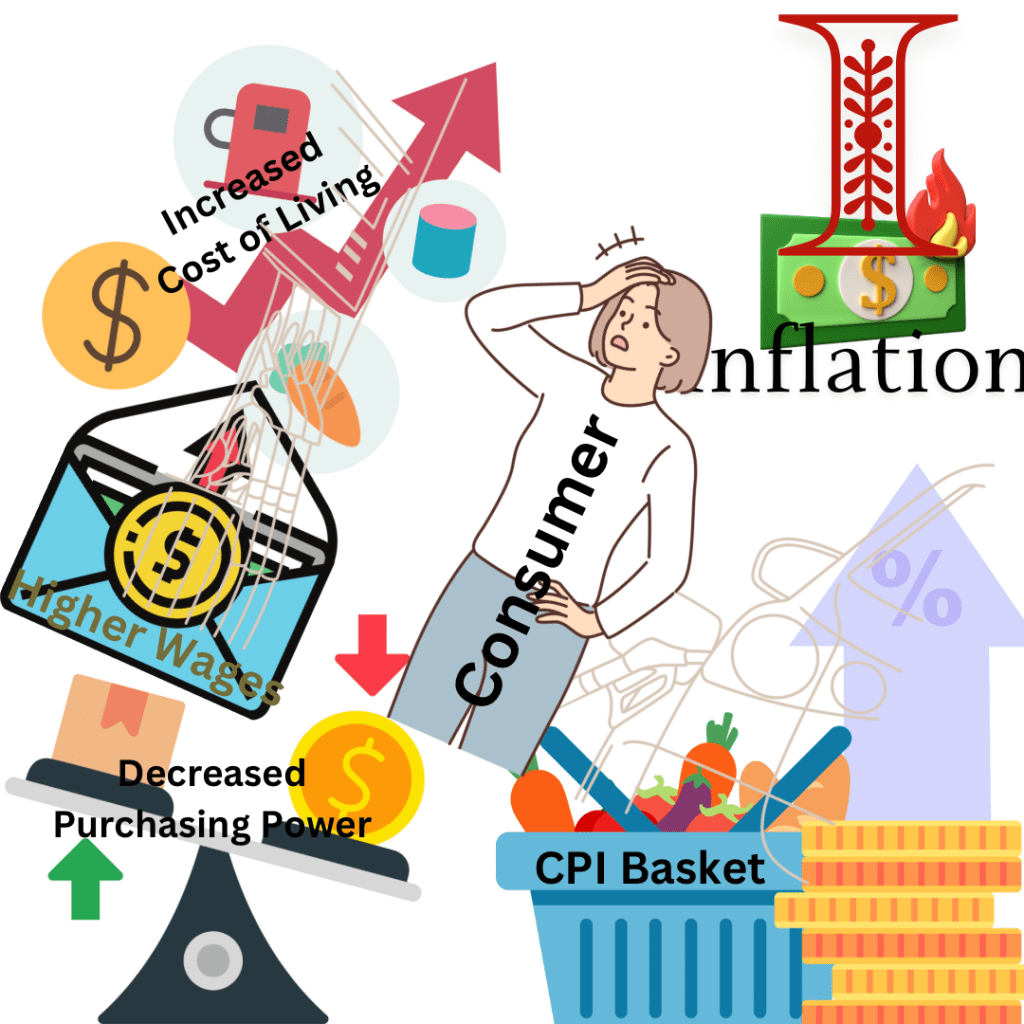
I received an email from Equifax, one of the credit bureaus on the above title and thought to both share it (in the link below) and write on it for my Monday Financial nuggets.
The email was a reminder to know how much your credit cards will be costing you and to use credit wisely during the period of inflation.
It will be a good read for you if you have any type of debt.
Inflation
You may have noticed that the prices of goods; that is, groceries, food, consumer staples, etc. have gone up over the period. If you haven’t, look around you some more or you’re probably on a prolonged vacation on another planet.
The corresponding action is that labor unions have fought for, and won, increased wages. Now resulting in too many dollars chasing too few goods.
This is Inflation; “a persistent, substantial rise in the general level of prices related to an increase in the volume of money and resulting in the loss of value of currency.”
What Is the Inflation for Each Year?
Without getting deep into Economics, “the inflation rate is the percentage change in the price of products and services from one year to the next. Two of the most common ways to measure inflation are the Consumer Price Index (CPI) calculated by the Bureau of Labor Statistics (BLS) and the personal consumption expenditures (PCE) price index from the Bureau of Economic Analysis (BEA).
An average rate of inflation can be calculated for each year:
- In 2024, as of April, the rate of inflation is 3.4%
- In 2023, the average rate of inflation was 4.1%.
- In 2022, the average rate of inflation was 8.0%.
- In 2021, the average rate of inflation was 4.7%.
- In 2020, the average rate of inflation was 1.2%.” (investopedia.com)
As you can see from the above rate list, though the inflation rate has decreased since 2022, it almost quadrupled and doubled respectively the two years shortly after the onset of COVID. However, we’re still not at the pre-COVID rate. Consumers are still feeling the pinch post-COVID.
Causes and Costs of Inflation
Causes of Inflation
1. Demand-Pull Inflation:
- Occurs when the demand for goods and services exceeds supply.
- Example: During an economic boom, consumers have more disposable income, leading to increased spending. This was seen in the post-World War II era when economic growth led to a surge in demand, causing prices to rise.
- 2. Cost-Push Inflation:
- Arises when the costs of production increase, leading to higher prices for consumers.
- Example: The 1970s oil crisis saw oil prices skyrocket due to geopolitical tensions, significantly increasing production costs across various industries, which then passed these costs onto consumers.
3. Built-In Inflation:
- Linked to adaptive expectations where workers demand higher wages to keep up with rising living costs, leading to a wage-price spiral.
- Example: If a country experiences inflation, employees might demand higher wages. Businesses then increase prices to cover higher wage costs, perpetuating a cycle of inflation.
4. Monetary Policy:
- Excessive money supply growth can devalue currency, leading to inflation.
- Example: Zimbabwe in the late 2000s printed large amounts of money to pay off debts, causing hyperinflation where prices doubled every day.
5. External Shocks:
- Unexpected events that disrupt supply chains or significantly alter demand.
- Example: The COVID-19 pandemic led to supply chain disruptions and changes in consumer behavior, contributing to inflationary pressures globally.
Costs of Inflation
1. Decreased Purchasing Power:
- Inflation erodes the value of money, meaning consumers can buy less with the same amount of money.
- Example: In the 1980s, the US experienced high inflation rates, reducing the real income of households and limiting their ability to purchase goods and services.
2. Uncertainty and Reduced Investment:
- High and unpredictable inflation creates uncertainty, making it difficult for businesses to plan for the future.
- Example: In Argentina, persistent high inflation has led to a lack of confidence among investors, reducing foreign direct investment and slowing economic growth.
3. Menu Costs:
- The costs associated with changing prices frequently.
- Example: Restaurants printing new menus, retailers updating price tags, and the administrative burden of constantly adjusting prices.
4. Shoe Leather Costs:
- Increased costs related to managing cash holdings, like more frequent trips to the bank.
- Example: In hyperinflation scenarios, individuals might withdraw money more often to avoid holding devaluing cash, as seen in Germany during the 1920s hyperinflation period.
5. Distorted Spending Patterns:
- Inflation can lead to consumers and businesses making inefficient spending and investment decisions.
- Example: If people expect prices to rise, they might rush to buy durable goods, distorting market signals and leading to overconsumption or misallocation of resources.
6. Inequality:
- Inflation can disproportionately affect those on fixed incomes, such as retirees.
- Example: If pension payments do not adjust with inflation, retirees find their purchasing power significantly reduced, increasing economic inequality.
Conclusion
Inflation, while a normal aspect of economic cycles, can have profound impacts on the economy and individuals. Understanding its causes, from demand-pull to external shocks, and its costs, such as decreased purchasing power and investment uncertainty, is crucial for policymakers to mitigate its adverse effects. By managing inflation effectively, economies can strive for stability and sustainable growth.
The Impact of Inflation on Consumers
1. Decreased Purchasing Power
Inflation directly reduces the value of money, meaning consumers can buy less with the same amount of money.
- Example: If the inflation rate is 5%, an item that cost $100 a year ago will now cost $105. For consumers whose incomes do not increase at the same rate, this means their ability to purchase goods and services diminishes.
2. Increased Cost of Living
As prices rise, the cost of everyday necessities like food, housing, and transportation also goes up.
- Example: In the UK, rising inflation in 2022 led to significant increases in grocery and energy prices, forcing many households to cut back on discretionary spending or dip into savings.
3. Wage-Price Spiral
Inflation often leads to higher wages as workers demand more pay to keep up with rising prices, but this can further fuel inflation if businesses pass on the higher wage costs to consumers through increased prices.
- Example: In the late 1970s, the US experienced a wage-price spiral where unions successfully negotiated higher wages, but businesses then increased prices, perpetuating the inflation cycle.
4. Erosion of Savings
Money saved in bank accounts loses value over time if the interest rates on savings do not keep up with inflation.
- Example: If a consumer has $10,000 in a savings account earning 1% interest annually but inflation is 3%, the real value of their savings declines, reducing their purchasing power over time.
5. Increased Borrowing Costs
To combat inflation, central banks often raise interest rates, making loans and credit more expensive.
- Example: When the Federal Reserve increases the interest rate, mortgage rates go up, making home loans more expensive. This impacts consumers looking to buy homes or refinance existing mortgages.
6. Altered Spending Habits
Consumers may change their spending habits, focusing on immediate purchases rather than saving or investing.
- Example: If consumers expect prices to keep rising, they might purchase durable goods like appliances and cars sooner rather than later, leading to short-term spikes in demand and further inflationary pressures.
7. Impact on Fixed-Income Households
Those on fixed incomes, such as retirees, are particularly vulnerable because their income does not increase with inflation.
- Example: Pensioners in countries with high inflation may struggle to afford basic necessities if their pension payments do not adjust with the rising cost of living.
8. Increased Debt Burden
For consumers with variable-rate loans, higher interest rates increase monthly payments, reducing disposable income.
- Example: A consumer with a variable-rate mortgage may see their monthly payments increase as interest rates rise, putting additional strain on their finances.
9. Reduced Confidence and Economic Uncertainty
High inflation can lead to economic uncertainty, reducing consumer confidence and spending.
- Example: During periods of high inflation, such as in Argentina, consumers may become more cautious with their spending, saving more as a hedge against future price increases, which can slow economic growth.
Conclusion
Inflation affects consumers in multiple ways, from decreasing purchasing power and increasing the cost of living to altering spending habits and impacting those on fixed incomes. Understanding these impacts is crucial for consumers to adapt their financial strategies and for policymakers to implement measures to mitigate inflation’s adverse effects. By recognizing and addressing the challenges posed by inflation, both individuals and economies can better navigate periods of rising prices.
Strategies for Consumers to Navigate Inflation
1. Budget Adjustment and Expense Tracking
Carefully reviewing and adjusting your budget can help manage increased costs.
- Action: Track all your expenses to identify areas where you can cut back. Prioritize essential expenses like housing, utilities, and groceries, and reduce discretionary spending on non-essentials.
2. Increase Savings and Build an Emergency Fund
Having a financial cushion can provide security during inflationary periods.
- Action: Aim to save a portion of your income each month, even if it’s a small amount. Building or bolstering an emergency fund can help cover unexpected expenses without relying on high-interest credit.
3. Shop Smart and Take Advantage of Discounts
Being strategic about shopping can help mitigate rising costs.
- Action: Use coupons, loyalty programs, and sales to reduce costs. Consider buying in bulk for items that have long shelf lives and comparing prices across different stores to find the best deals.
4. Consider Fixed-Rate Loans
Locking in interest rates can protect you from future increases.
- Action: If you have variable-rate loans or mortgages, explore options for refinancing to fixed-rate terms. This can provide more predictable monthly payments and shield you from rising interest rates.
5. Invest in Inflation-Protected Securities
Certain investments can provide a hedge against inflation.
- Action: Consider diversifying your investment portfolio with assets like Treasury Inflation-Protected Securities (TIPS), which adjust with inflation, or commodities like gold that often retain value during inflationary periods.
6. Enhance Income Streams
Boosting your income can help offset rising costs.
- Action: Look for opportunities to increase your income through side gigs, freelance work, or seeking a raise at your current job. Upskilling or reskilling can also lead to better job opportunities and higher wages.
7. Reduce Debt
Paying down debt can free up more of your income and reduce financial stress.
- Action: Focus on paying off high-interest debt first, such as credit card balances. Reducing your debt load can improve your financial stability and reduce the impact of rising interest rates on your budget.
8. Stay Informed and Adapt
Keeping up with economic trends can help you make informed decisions.
- Action: Follow financial news and updates from reliable sources. Being aware of inflation trends and economic policies can help you anticipate changes and adapt your financial strategies accordingly.
9. Negotiate for Better Rates and Terms
Proactively managing your expenses and contracts can yield savings.
- Action: Contact service providers to negotiate better rates on things like insurance, phone plans, and internet services. Also, shop around for better deals on essential services and utilities.
10. Consider Long-Term Investments in Education and Skills
Investing in yourself can lead to better financial stability in the long run.
- Action: Pursue education and training opportunities that can lead to higher-paying jobs. This can provide a buffer against inflation by increasing your earning potential.
Conclusion
Navigating inflation requires a combination of strategic financial planning, smart spending habits, and proactive income management. By adjusting your budget, increasing savings, and making informed investment choices, you can mitigate the impact of rising prices on your financial well-being. Staying informed and adaptable will further equip you to handle economic uncertainties and maintain financial stability during inflationary periods.
🥂to your financially-informed and inflation-proof self
 Think-Talk