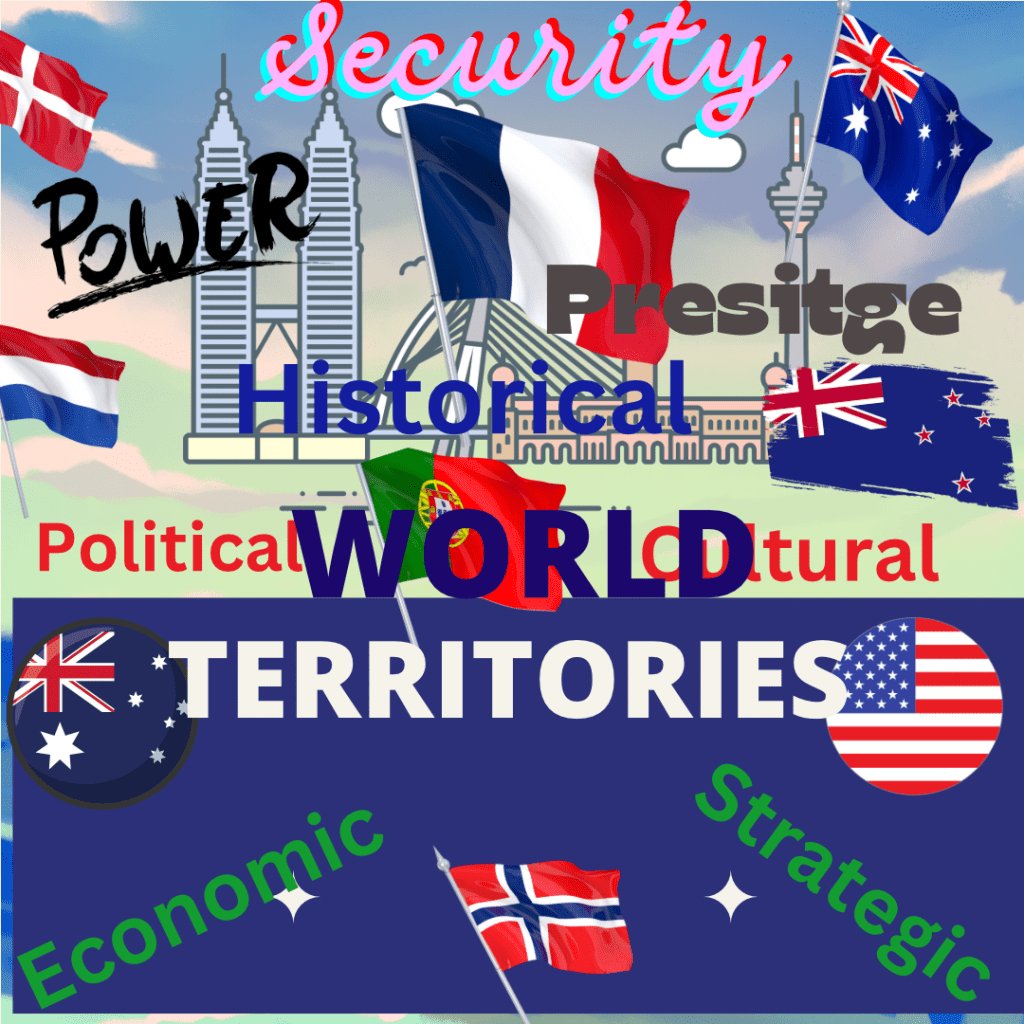
It is absurd that a smaller capacity country will hold a bigger one as a Territory or dependent state. Often, it’s the mightier and stronger capacity countries’ forte. But, why does it happen?
Call me naive or ignorant, but after posting the World Territories yesterday, I pondered on several questions about why the Territories still remain and what it will take for those Territories to gain their independence. It’s a form of control in various forms; economic, political, cultural, strategic, etc. Here’s what I found:
Powerful countries often hold lesser ones as territories for several reasons:
1. Strategic Advantage:
Control over a territory can provide significant military and strategic benefits. It can serve as a base for military operations, a buffer zone against potential threats, or a means to project power in a region.
2. Economic Interests:
Territories can be rich in natural resources, such as minerals, oil, or fertile land, which can be exploited for economic gain. Additionally, they can provide new markets for goods and services.
3. Political Influence:
Maintaining territories can enhance a country’s influence on the global stage. It allows the powerful country to exert political control and influence over regional and international affairs.
4. Cultural and Historical Ties:
Sometimes territories are retained due to historical, cultural, or colonial ties. These connections can foster a sense of national identity or historical continuity.
5. Security:
Controlling territories can enhance national security by preventing rival powers from gaining a foothold in strategically important areas.
6. Prestige:
Holding territories can be a symbol of national prestige and power, reflecting the country’s status as a dominant global player.
These motivations can vary in importance depending on the specific context and historical circumstances surrounding each territory.
The Process for Takeover
The process by which a powerful country comes to hold a lesser one as a Territory typically unfolds through several stages:
A. Exploration and Discovery:
Initially, powerful countries explore new regions, often driven by curiosity, the desire for new trade routes, or the quest for valuable resources.
B. Initial Contact and Trade:
After discovering new territories, powerful countries establish initial contact, often through trade. They may set up trading posts and begin to establish a presence.
C. Colonization and Settlement:
As interest in the territory grows, powerful countries often move to colonize it. This can involve sending settlers, establishing administrative structures, and building infrastructure to support their control.
D. Economic Exploitation:
The colonizing country begins to exploit the territory’s resources, including minerals, agricultural products, and labor. This phase often includes the imposition of economic systems that benefit the colonizing country.
E. Military Control and Suppression:
To maintain control and suppress resistance, powerful countries frequently deploy military forces. This can involve conflicts with indigenous populations and other rival powers.
F. Formal Annexation:
Over time, the powerful country may formally annex the territory, incorporating it into its political and administrative structure. This can involve treaties, coercion, or outright conquest.
G. Cultural and Social Integration:
The colonizing country often attempts to integrate the territory culturally and socially. This can include imposing language, education systems, and cultural norms.
H. Governance and Administration:
The powerful country establishes governance structures to administer the territory. This can involve appointing governors, creating colonial administrations, and implementing laws.
I. Resistance and Independence Movements:
Over time, resistance to foreign control often grows within the territory. This can lead to independence movements and conflicts aimed at achieving self-determination.
J. Decolonization and Independence:
In the modern era, many territories have gained independence through decolonization processes, often following significant political and social movements both within the territory and globally.
The specific trajectory can vary significantly based on historical, geographical, and political factors unique to each situation.
Resorting to War and Violence?
No one would think to takeover somebody else’s property without a fight. Right? So it is that countries often resort to war and violence in the process of acquiring and maintaining control over territories. This can occur at various stages and take different forms:
I. Initial Conquest:
Powerful countries may use military force to conquer and subdue a territory. This can involve large-scale battles, sieges, and violent suppression of resistance from indigenous populations or rival powers.
II. Suppression of Resistance:
Once a territory is under control, there is often continued resistance from the local population. The powerful country may use violence to suppress uprisings, revolts, and insurgencies. This can include punitive expeditions, massacres, and other forms of repression.
III. Colonial Wars:
In some cases, colonizing countries engage in wars with other powerful nations over control of territories. These colonial wars can be protracted and devastating, involving both the colonizing powers and the local populations caught in the conflict.
IV. Forced Labor and Slavery:
The economic exploitation of territories often involves the use of forced labor, including slavery. This system is maintained through violence and coercion, leading to significant suffering and loss of life among the indigenous and enslaved populations.
V. Cultural Suppression and Genocide:
The imposition of control can also involve cultural suppression, forced assimilation, and in extreme cases, acts of genocide aimed at eradicating local cultures and populations.
VI. Wars of Independence:
Territories seeking independence from colonial powers often resort to armed struggle. These wars of independence can be lengthy and brutal, involving guerrilla warfare, civil wars, and widespread violence.
Examples of such conflicts include the Spanish conquest of the Americas, the British suppression of the Indian Rebellion of 1857, the Scramble for Africa leading to numerous colonial wars, and the various wars of independence in the 20th century, such as the Algerian War of Independence against France.
While some territories have been acquired or maintained through diplomatic means and treaties, the use of war and violence has been a common and significant aspect of the historical process of territorial expansion and control.
How can the Territories become Independent?
Territories can achieve independence through a variety of pathways, often involving a combination of political, social, and economic factors. Here are the primary methods through which Territories gain independence:
AA. Negotiated Settlement:
Independence can be achieved through diplomatic negotiations between the colonial power and the territory’s leadership. These negotiations often result in treaties or agreements that outline the terms of independence. Examples include India’s negotiated independence from Britain in 1947.
BB. Armed Struggle:
Many territories gain independence through armed struggle and revolutionary movements. This often involves prolonged conflict, guerrilla warfare, and significant sacrifice. Successful examples include Algeria’s war of independence from France (1954-1962) and the American Revolutionary War (1775-1783).
CC. International Pressure and Support:
International organizations, such as the United Nations, and influential countries can exert pressure on colonial powers to grant independence. Global public opinion, advocacy, and support from other nations can play a crucial role. The decolonization movement post-World War II was significantly influenced by international pressure and support.
DD. Referendums and Plebiscites:
Some Territories achieve independence through referendums or plebiscites, where the population votes on their desire for independence. This method provides a democratic and peaceful pathway to independence. An example is the 2011 referendum in South Sudan, which led to its independence from Sudan.
EE. Legal and Constitutional Processes:
Independence can also be achieved through legal and constitutional means within the framework of the colonizing country’s legal system. This often involves legislative changes, constitutional amendments, and legal agreements. Canada and Australia, for instance, became fully independent through gradual legal processes culminating in the Statute of Westminster (1931) and the Australia Act (1986), respectively.
FF. Civil Disobedience and Nonviolent Resistance:
Nonviolent movements, characterized by civil disobedience, protests, and strikes, can effectively challenge colonial rule and build momentum for independence. Mahatma Gandhi’s nonviolent resistance movement in India is a notable example.
GG. Economic Factors:
Economic changes, such as the decline of a colonial power’s economic ability to maintain its territories or the economic growth and self-sufficiency of the territory, can facilitate independence. The economic burden of maintaining colonies contributed to the decolonization wave after World War II.
HH. Collapse of Colonial Power:
Sometimes, the internal collapse or significant weakening of the colonial power, due to factors like war, revolution, or economic crisis, leads to the granting of independence. The dissolution of the Soviet Union in 1991 resulted in the independence of many former Soviet republics.
Each Territory’s path to independence is unique, often involving a combination of these methods and influenced by local, regional, and global factors.
What are your thoughts on this – would you like your state to be a Territory taken over by a mightier state? Or do you suppose that Territory takeovers are a part of world affairs? Pen your thoughts in the comments.
Thanks for reading.


Great piece. check out http://citypressjournal.wordpress.com for yourself…
LikeLiked by 1 person
Thank you, CLCouch123. Much appreciated.
LikeLike
I greatly appreciate your descriptions of the reasons for, the attributes of, and the consequences inside territories. The third listing of what might happen and, in fact, the processes regarding independence is telling even for success (maybe too hard-won). For why have these in-between possessions (so to speak), not self-determining, not other-determining either (say, for statehood)? All the descriptions are constructed with comprehensive (as in thorough) clarity.
LikeLike