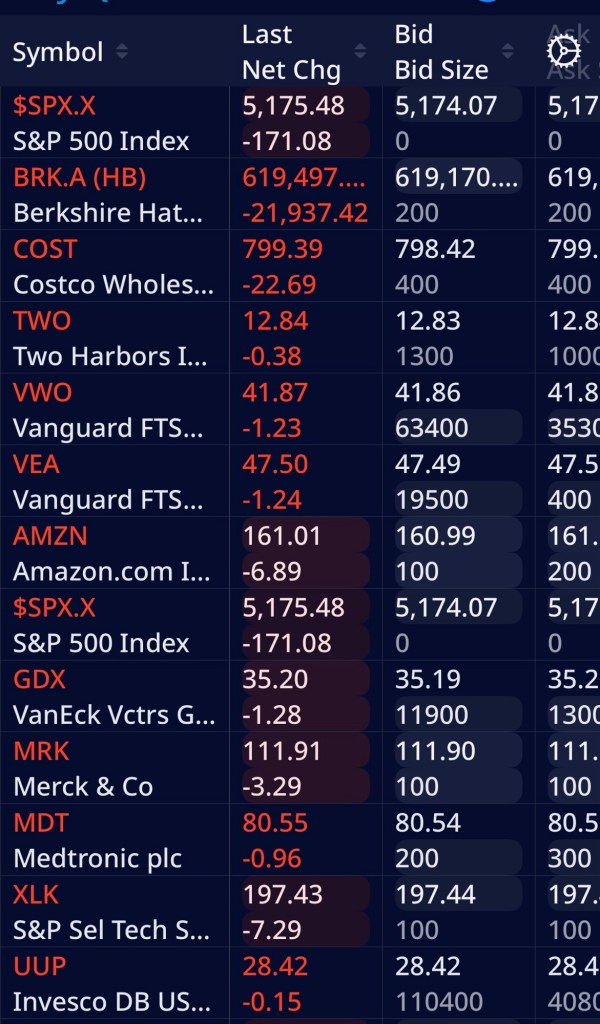
Nasdaq is down a 1,000 points! Dow loses almost 3%, Japanese suffers the worst since 1957 dropping 12%! Even the crypto markets are crashing. Lord have mercy!
Red on the watchlist board signifies that the stocks fell in prices. But it is always an opportunity to buy more of those stocks.
Green is always Good
After the gloomy last week that continued till yesterday, we woke up this morning to a market that’s bouncing back! Praise God!!

Stock Market Volatility
The stock market is extremely volatile. Extremely so that such things as a statement from the President, Warren Buffet, the Fed or executives of any of the top tech companies could impact it. Not to mention events occurring in our nation or globally that impacts America, including what is known as the yen “carry trade.”
For example, Japan surprisingly increased its rate, from 0 to 0.25%, on Friday. This increase tremendously impacted global borrowings.
Economic Factors
The global stock markets have been navigating a volatile and complex landscape since the beginning of the year. Several economic factors have contributed to this environment, including inflationary pressures, geopolitical tensions, and varying economic policies across countries.
Inflation and Monetary Policy
Inflation has been a persistent issue, with many countries experiencing higher-than-expected rates. Central banks, including the Federal Reserve in the United States and the European Central Bank, have responded with interest rate hikes to combat rising prices. These measures have impacted market liquidity and investor sentiment, leading to increased volatility in stock prices.
Geopolitical Tensions
Geopolitical tensions, particularly in Eastern Europe and Asia, have also played a significant role in market fluctuations. The ongoing conflict in Ukraine, Hamas, and rising tensions between China and Taiwan have created uncertainty, affecting global supply chains and investor confidence.
Economic Policies
Divergent economic policies across major economies have also influenced market dynamics. While the United States and some European countries have adopted more aggressive monetary tightening, other regions, such as Japan and China, have taken a more accommodative stance to stimulate growth. These differing approaches have created varying opportunities and risks for investors. Japan, however and surprisingly, increased its rates last week.
Recommendations for Investors
Given the current state of the global stock markets, investors need to adopt a strategic and diversified approach to navigate these uncertain times. Here are some recommendations:
- Diversify Your Portfolio. Diversification remains a fundamental strategy for managing risk. Investors should spread their investments across different asset classes, sectors, and geographical regions. This approach helps mitigate the impact of adverse events in any single market or sector.
- Focus on Quality. In times of volatility, quality stocks—companies with strong balance sheets, consistent earnings, and competitive advantages—tend to perform better. Investors should prioritize these high-quality stocks as they are more likely to weather economic downturns and provide stable returns over the long term.
- Consider Defensive Sectors. Defensive sectors, such as healthcare, consumer staples, and utilities, often exhibit resilience during market downturns. These sectors provide essential goods and services that remain in demand regardless of economic conditions, making them attractive options for risk-averse investors.
- Stay Informed and Agile. The global market landscape can change rapidly. Investors should stay informed about economic indicators, corporate earnings reports, and geopolitical developments. Being agile and ready to adjust investment strategies in response to new information is crucial for navigating volatile markets.
- Think Long-Term. While short-term market fluctuations can be unsettling, it’s essential to maintain a long-term perspective. Historical data shows that markets tend to recover and grow over time. Investors with a long-term horizon should stay focused on their investment goals and avoid making impulsive decisions based on short-term market movements.
- Explore Emerging Markets. Emerging markets can offer growth opportunities that are less correlated with developed markets. Countries in Asia, Latin America, and Africa may provide attractive investment prospects, particularly in sectors like technology, infrastructure, and consumer goods. However, these markets also come with higher risks, so thorough research and careful consideration are necessary.
Conclusion
The global stock markets in 2024 present a challenging yet dynamic environment for investors. By adopting a diversified, quality-focused, and informed investment strategy, investors can navigate the volatility and position themselves for long-term success. Staying agile and maintaining a long-term perspective are key to thriving in this ever-evolving market landscape.
Disclaimer:
Think-Talk is not a financial advisor. Do your due diligence and consult with a financial advisor before investing or trading in the stock market.


My Pleasure 👍🏻🤗
LikeLike
Thank you for reading. Stock investment is always for the long haul, except you’re trading. But most will panic and be depressed for losing when the market declines. As a matter of fact, the market bounced back to its original state, and a few, today 😊
I appreciate your comment. Thanks
LikeLike
Thanks for sharing these insights—it’s helpful to have such a comprehensive view on managing investments in such a dynamic environment.
LikeLike