
We all know what capitalism is and have heard of philanthropy and Corporate Social Responsibility (CSR). But have you heard of Philanthrocapitalism? How much exactly do you/we really know? Are these terms actually working for our society or are they funnels for more founders’ profits? Is it possible to do good while profiteering – can both work together? Read on and voice your opinion(s) in the Comments.
1. Philanthrocapitalism Model
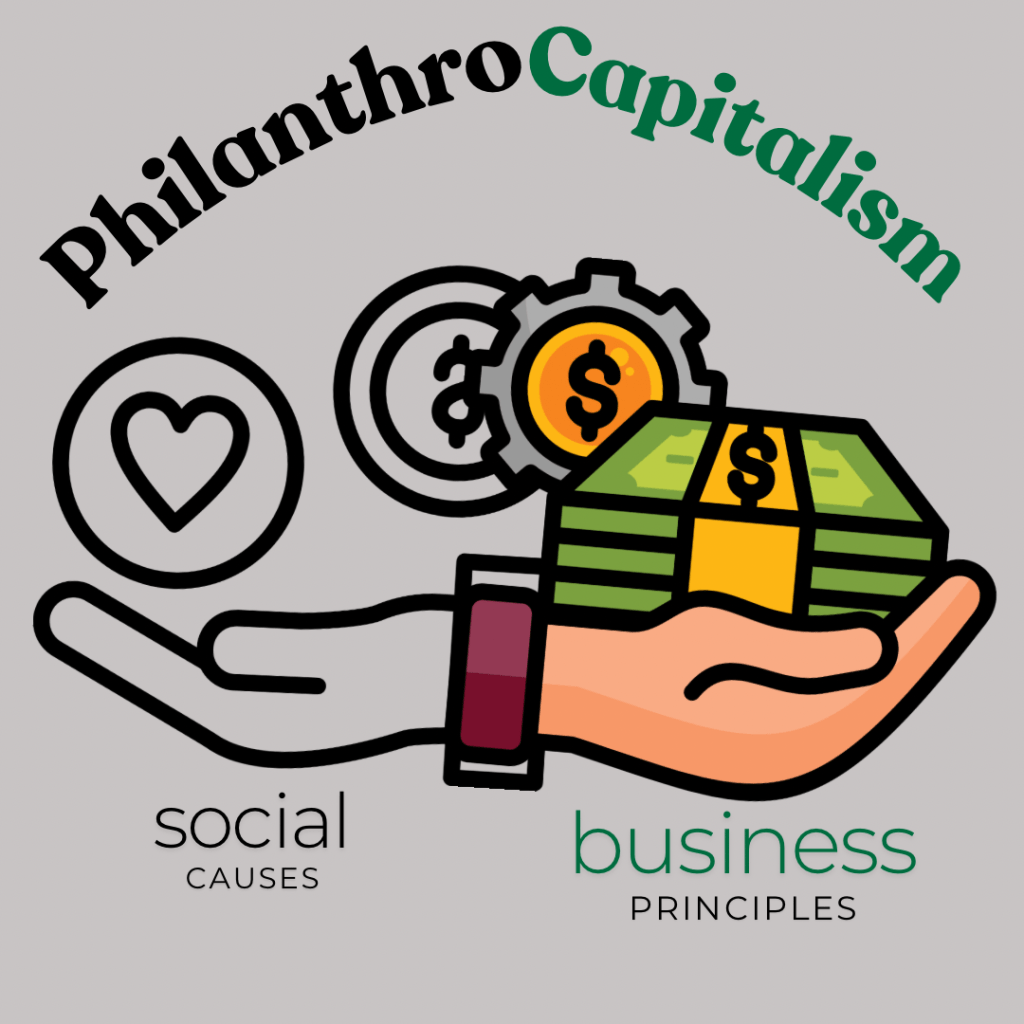
Philanthrocapitalism is an evolving approach to philanthropy where wealthy individuals or corporations apply business principles to social causes. The idea is to use capital and entrepreneurial strategies to drive social impact, essentially treating social issues like market opportunities that can be optimized for results. This model often aims for measurable outcomes and long-term sustainability, much like any other business venture.
How Philanthrocapitalism Works
Market-based Solutions:
In philanthrocapitalism, the solution to social issues is often framed in terms of market dynamics—investing in innovative, scalable solutions. For instance, a billionaire may invest in a social enterprise that focuses on providing affordable healthcare or renewable energy to underserved communities. This isn’t purely charity; it’s about creating self-sustaining businesses that can solve these issues long-term, and ideally, yield financial returns.
Investment with Impact:
The goal is often to “do good” while making money. Instead of giving away money in the traditional sense, philanthropists seek to establish or fund businesses that solve social problems, often through investments or venture capital. By funding these social enterprises, they expect a financial return, alongside social outcomes like job creation, improved education, or better access to clean water.
Examples of Philanthrocapitalism:
Philanthrocapitalism is increasingly popular among wealthy individuals and corporations, and several foundations are exemplifying this approach by leveraging market-driven solutions to solve social issues. Below are some notable examples:
1. Bill and Melinda Gates Foundation. Through its investments in global health, education, and poverty alleviation, the Gates Foundation focuses on measurable results. They fund initiatives that seek to solve issues like malaria eradication or improving access to vaccines, but they also place a strong emphasis on tracking the return on investment.
2. The Chan Zuckerberg Initiative (CZI). Founded by Mark Zuckerberg and Priscilla Chan, focuses on health, education, science, and justice reform. The Chan Zuckerberg Initiative applies venture capital and entrepreneurial strategies to philanthropy, aiming to create scalable, data-driven solutions to major social issues. The initiative focuses heavily on using technology and research to improve health, cure diseases, and improve educational outcomes. One of their most ambitious projects is to use science and technology to “cure, prevent, or manage all diseases” by the end of the century. They invest in biomedical research, educational tools, and criminal justice reform, often with a data-driven approach that mirrors startup culture.
3. The Rockefeller Foundation. Focuses on global health, sustainable development, climate change, and economic opportunity. Founded by John D. Rockefeller, the Rockefeller Foundation is a pioneer in applying business and market-driven approaches to solving social issues. Their focus includes global health programs, particularly in poor countries, where they use venture philanthropy to fund social enterprises that tackle systemic challenges. They often fund initiatives that aim to make markets more inclusive, such as investments in clean energy, affordable healthcare, and agricultural sustainability.
One of the foundation’s notable efforts is its investment in “Pay-for-Success” programs, which focus on funding social enterprises and organizations based on their ability to achieve measurable outcomes. This creates a link between investment and social impact, pushing businesses and nonprofits alike to focus on scalable solutions that have quantifiable results.
4. The Eli and Edythe Broad Foundation whose founders are Eli and Edythe Broad, focuses on education, science, and the arts. The Broad Foundation is known for its involvement in education reform. The foundation works with school districts and private organizations to apply business principles to public education, seeking ways to improve public school systems. The foundation advocates for charter schools, accountability measures, and data-driven reforms in education. Their approach is one of efficiency, seeking to turn struggling schools into viable, sustainable entities through business strategies like management consulting and performance-based incentives.
5. The Omidyar Network founded by Pierre Omidyar (eBay Founder), focuses on human rights, economic development, technology, and education. Omidyar Network is known for its focus on venture philanthropy, where it invests in for-profit companies that align with its social mission. The network supports startups and enterprises that aim to create social impact through technology, such as businesses focused on financial inclusion, education, and governance. They often work to incubate and scale businesses that can tackle significant challenges in developing economies, with a focus on self-sustaining solutions.
Pros of Philanthrocapitalism
• Scalable Solutions: One of the key advantages is the potential for large-scale impact. Since the approach applies business thinking to social challenges, the solutions can be highly scalable. Instead of just providing temporary relief, the goal is to create systems that can continuously improve lives without relying on perpetual donations.
• Innovation and Efficiency: Philanthrocapitalists often push for innovation in social sectors. This can lead to novel solutions and more efficient ways to address long-standing issues like hunger, disease, or education gaps.
• Sustainability: Because it’s tied to market forces, philanthropists aim to create models that are financially sustainable. This contrasts with traditional charity models, which rely heavily on donations and government funding.
Criticism of Philanthrocapitalism
• Profit-Driven: Critics argue that philanthrocapitalism is still profit-driven, which can sometimes distort the goals of the charity. For example, some social enterprises may prioritize profitable outcomes over real societal change, potentially sidelining more pressing needs that don’t have clear financial returns.
• Inequitable Power Structures: By creating systems where the wealthy have the power to direct resources, philanthrocapitalism can reinforce existing power dynamics. The decision-making is still in the hands of the philanthropist or their appointed board, which can sometimes lead to solutions that are more beneficial to the wealthy than to the people they claim to help.
• Accountability and Transparency: As philanthropists often manage their giving through private foundations, critics argue that there is a lack of accountability and transparency in how funds are spent. Without the scrutiny that comes with government programs or public welfare, these initiatives can operate with minimal oversight, potentially diverting funds or using them in ways that don’t maximize impact.
2. Corporate Social Responsibility (CSR)
CSR refers to a company’s commitment to contribute positively to society and the environment while conducting business in an ethical, sustainable, and socially responsible manner. The idea is that businesses should not only focus on profits but also take into account their impact on the world, right?! – whether through the environment, social causes, or the communities in which they operate.
How CSR Works
Environmental Impact:
Companies with strong CSR programs may focus on reducing their carbon footprint, adopting sustainable practices, or investing in green technologies. For instance, tech companies like Apple and Google have made significant strides in shifting towards renewable energy to power their data centers.
Community Engagement:
CSR also involves direct community involvement. Companies often donate money to local charities, fund educational programs, or support disaster relief efforts.
Employee Welfare:
Many CSR initiatives focus on the welfare of employees, ensuring fair wages, benefits, and a healthy work-life balance.
Ethical Business Practices:
Some companies, as part of CSR, will focus on ethical business practices, such as fair trade, transparent supply chains, or ensuring that their production doesn’t exploit labor or harm the environment.
Pros of CSR
• Positive Public Image: Companies that invest in CSR programs often enhance their reputation and public image, which can increase customer loyalty. Consumers today are more likely to support brands that they believe are socially responsible and environmentally conscious.
• Employee Morale and Recruitment: CSR programs can foster a positive work culture, improve employee satisfaction, and attract top talent. It’s often said that companies with a strong commitment to social causes often find that their employees feel more engaged and motivated, leading to increased productivity.
• Social Impact: Well-executed CSR programs can have tangible benefits on local communities, the environment, and public welfare. Through charitable contributions, volunteer programs, and environmental sustainability initiatives, companies can have a direct and lasting positive impact.
Criticism of CSR
• “Greenwashing”: One of the main criticisms of CSR is the concept of “greenwashing”—where companies claim to be socially or environmentally responsible without actually making substantial changes. Some companies may market themselves as eco-friendly or socially conscious while continuing to engage in practices that harm the environment or exploit workers, creating a false image of corporate responsibility.
• Profit Over Purpose: Similar to philanthrocapitalism, CSR can sometimes be seen as a strategy to boost profits and public visibility while doing the bare minimum to address social issues. While companies may invest in charity or sustainability initiatives, critics argue that these efforts are often more about enhancing the company’s bottom line and image than creating meaningful change.
• Limited Scope: In some cases, CSR programs may focus on surface-level issues or cause marketing that doesn’t address the systemic issues at the heart of the problems. For instance, a company might donate to charity without addressing the ethical concerns in its own supply chain, such as child labor or unsafe working conditions.
CSR Greenwashing
While many companies have adopted CSR initiatives to demonstrate their social and environmental commitment, some of these initiatives are seen as more marketing ploys than genuine efforts to make a lasting impact. Here are a few examples of notable CSR greenwashers:
1. Walmart’s CSR Program: Walmart is a well-known example of a company whose CSR initiatives have received both praise and criticism. While it invests in sustainability programs and community development, its critics argue that its core business model—offering low wages to employees and relying on cheap, often exploitative labor in developing countries—undermines its CSR efforts. Despite its charitable donations and efforts toward reducing environmental impact, many argue that Walmart’s overall business practices contradict the very values it promotes through CSR.
2. BP (British Petroleum). BP, in an effort to rebrand itself, introduced its “Beyond Petroleum” campaign in the early 2000s, positioning itself as a leader in renewable energy. However, critics argue that while the company promoted its investments in wind and solar energy, it continued to heavily invest in fossil fuels, with the majority of its revenue still coming from oil and gas. In the years following the campaign, BP’s involvement in renewable energy has remained limited compared to its ongoing dependence on environmentally harmful practices, such as deepwater drilling and oil exploration.
3. Nestlé. Nestlé has faced significant backlash regarding its CSR practices, especially in relation to its bottled water business. The company has promoted efforts to improve water usage efficiency and sustainability, but at the same time, it has been criticized for extracting water from communities with scarce resources, particularly in California and developing countries. Critics argue that Nestlé’s water bottling practices are harmful to local ecosystems and communities, despite its CSR campaigns that highlight sustainability and water stewardship.
4. Coca-Cola. Coca-Cola has marketed itself as a leader in sustainability, with campaigns focusing on reducing carbon emissions, improving water efficiency, and recycling. However, the company has been heavily criticized for contributing to plastic pollution, being one of the largest producers of single-use plastic bottles. Despite its efforts to promote recycling and sustainability, Coca-Cola continues to face criticism for its environmental impact, particularly the volume of waste generated by its packaging. The company’s “sustainability” messages are often seen as a diversion from its actual environmental footprint.
5. Shell (a subsidiary of Royal Dutch Shell PLC, a giant oil company headquartered in The Hague, Netherlands). Similar to BP, Shell has launched green campaigns emphasizing its efforts to transition to renewable energy. They claim to be part of the solution to the climate crisis with investments in biofuels, wind energy, and carbon capture technologies. However, critics argue that Shell’s actions still heavily prioritize oil and gas exploration. Shell has also been accused of oil spills resulting in environmental pollutions and several lawsuits in Nigeria and Europe. Despite its green campaigns, Shell continues to profit from fossil fuel extraction and is involved in controversial projects like drilling in the Arctic, which contradicts its environmentally friendly messaging.
Conclusion: A Balanced Perspective
While both philanthrocapitalism and CSR can lead to positive social outcomes when done authentically, there is a growing concern that some efforts are merely greenwashing or self-serving. For philanthrocapitalism, the challenge lies in ensuring that the pursuit of social impact doesn’t obscure profit motives, while for CSR, companies must go beyond marketing strategies and make meaningful changes to their operations to genuinely address social and environmental issues.
Both models are under intense scrutiny, and for these efforts to be truly impactful, they need to prioritize transparency, sustainability, and accountability—not just as a means to improve public image, but as a commitment to creating tangible, lasting change.
Both philanthrocapitalism and CSR are not inherently negative, but they can be critiqued for serving the interests of wealthy individuals or corporations more than the communities they aim to help. While these models have the potential to drive innovation and address pressing social issues, they are often intertwined with business objectives that make them a double-edged sword. The challenge lies in ensuring that these initiatives truly prioritize social good rather than serve as vehicles for profit or to enhance a company’s or individual’s brand.
Balancing altruism with business interests is a fine line. For long-term, meaningful impact, these efforts must be transparent, accountable, and rooted in genuine concern for social welfare, rather than as a means to cement power, preserve wealth, or improve public image.
Note:
The organizations mentioned are merely a sample of a larger number. Tons of organizations “guilty” of one or both philanthrocapitalism and negative CSR abound in our society.
As consumers, we need to understand what is happening and choose our patronage of such organizations wisely.
 Think-Talk