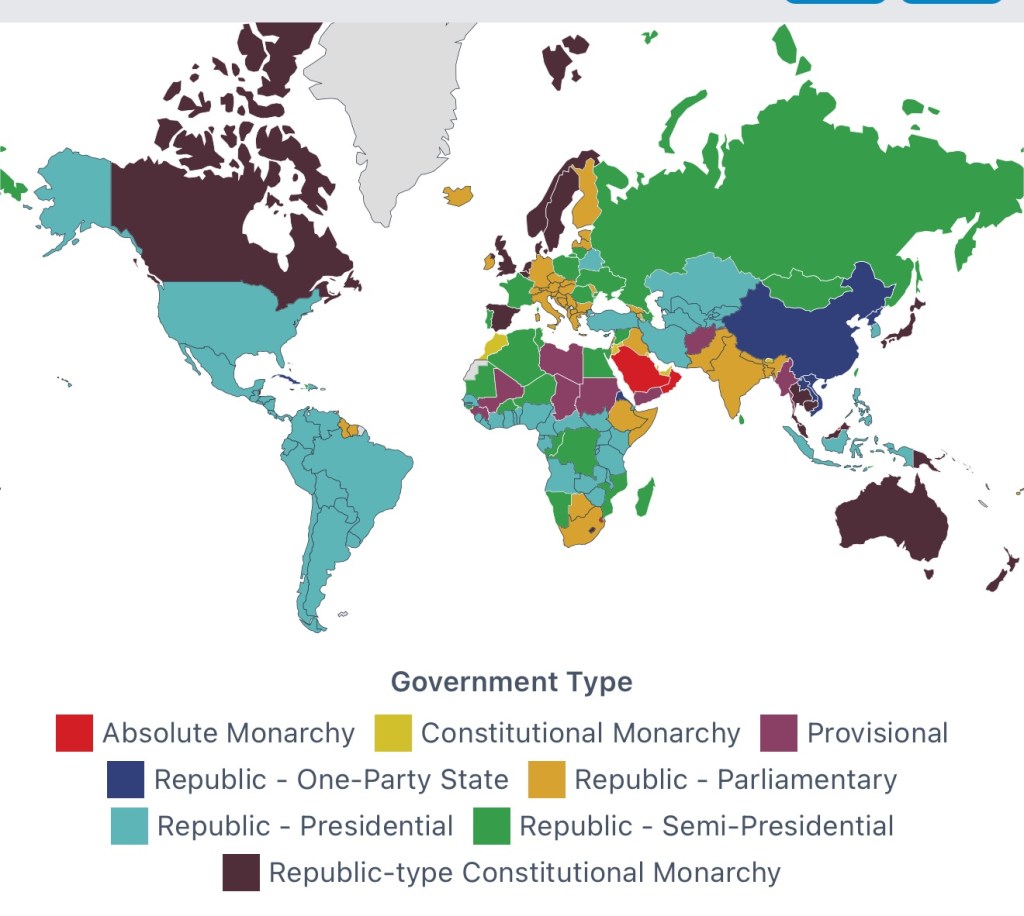
The world is a vast and diverse place, home to 196 recognized sovereign states. Of these, 194 are member states of the United Nations, while the remaining two—the Holy See (Vatican City) and Palestine—are recognized as observer states. Each country operates under its own unique system of governance, which determines how it is ruled and how power is distributed.
These systems can generally be categorized as republics, monarchies, or other hybrid systems, with further subtypes under each category. Of the 196, 43 are monarchies and 159 countries are Republics.
REPUBLICS
a form of government where the country’s power is held by the people …
The word “republic” comes from the Latin term res public, which means “public matter,” “public things,” or “public affair.” A republic is a form of government where the country’s power is held by the people, but instead of ruling directly, the people loan their power to elected representatives who represent them and their interests. The president or head of state is often an elected or appointed official.
The majority of the world’s countries are republics, but they differ significantly in their implementation as there are various types of Republics as seen in the map above.
Types of Republics
• Presidential Republics: In this system, the president serves as both the head of state and the head of government. Examples include the United States, Brazil, and Indonesia.
• Parliamentary Republics: Here, the head of state (often a president) is distinct from the head of government (the prime minister). The prime minister derives power from the parliament. Examples include Germany, India, and Italy.
• Single-Party Republics: These are states where only one political party is allowed, often leading to authoritarian rule. Examples include China, Cuba, and Vietnam.
• Federal Republics: These are republics composed of semi-autonomous regions or states, like Switzerland, Nigeria, and Russia.
MONARCHIES
A monarchy is a form of government where a monarch—such as a king, queen, sultan, or emperor—serves as the head of state. Monarchies are among the oldest forms of governance and still exist in various forms today.
Types of Monarchies
• Absolute Monarchies: The monarch holds almost all governing power, with little to no constitutional or legal limits. Examples include Saudi Arabia, Brunei, and Eswatini.
• Constitutional Monarchies: The monarch’s powers are largely symbolic and limited by a constitution, with real political power vested in elected officials. Examples include the United Kingdom, Japan, and Sweden.
• Elective Monarchies: Monarchs are elected rather than inheriting the position. An example is the Papal Monarchy of the Vatican, where the pope is elected.
OTHER SYSTEMS OF GOVERNANCE
In addition to republics and monarchies, several countries use hybrid or unique systems that don’t fit neatly into the above categories. These include:
• Theocracies: Religious leaders hold the highest authority, and laws are based on religious principles. Examples include Iran and the Holy See.
• Military Juntas: Governance is controlled by military leaders, often following a coup. An example is Myanmar (Burma) under military rule.
• Communist States: These are often single-party states that base governance on Marxist-Leninist ideology, like North Korea and Laos.
• Transitional States: These are countries in flux, either moving toward democracy or recovering from conflict, such as Libya or Sudan.
REGIONAL INSIGHTS
Africa:
Africa’s 54 countries are predominantly republics, with a few monarchies like Morocco and Eswatini. Many nations are transitioning toward democratic governance, though some still face political instability.
Asia:
Asia showcases a mix of systems, from the monarchies of Saudi Arabia and Thailand to the communist rule of China and Vietnam.
Europe:
Europe leans toward constitutional monarchies and parliamentary republics, with examples like Spain, Norway, and Germany.
The Americas:
North and South America are dominated by presidential and parliamentary republics, such as the United States, Canada, and Argentina.
Oceania:
Oceania includes constitutional monarchies like Australia (under the British crown) and republics like Fiji.
In conclusion, governance systems across the world reflect the historical, cultural, and social complexities of each country. While some nations embrace modern democratic principles, others adhere to age-old traditions of monarchy or religious governance. Understanding these systems not only enhances our global awareness but also highlights the diverse ways societies organize themselves to achieve order and development.
Note:
I’ve always thought that the United Kingdom was absolute monarchy. In doing this post I learned that the country is under a constitution. I should have known that, but …. How about you – did you learn something new? Let us know in the Comments.
 Think-Talk