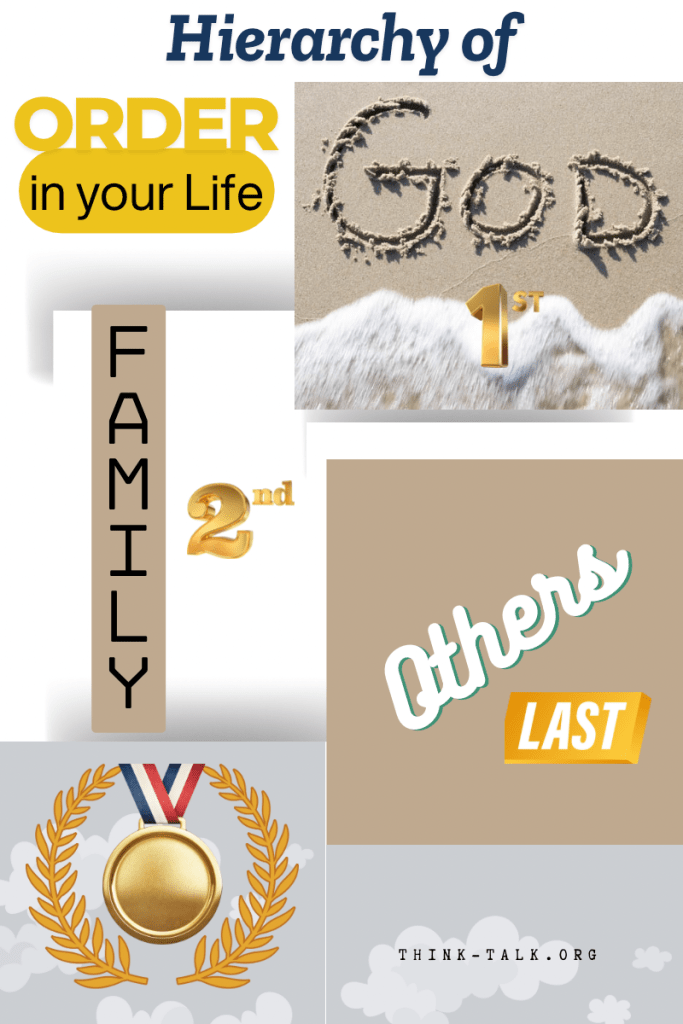
Do you have a framework for honoring people in your life? If not, I’ll offer you one and you let me know your thoughts on it.
The Bible says,
“Honor the Lord with your wealth, with the firstfruits of all your crops;”
Proverbs 3:9 NIV
And Jesus said:
“honor your father and mother,’ and ‘love your neighbor as yourself.’””
Matthew 19:19 NIV
From these two scriptures, was this framework formed. Here it is::
God first,
family second,
all others last.
This order establishes a clear and structured hierarchy of priorities in life, particularly from a faith-based perspective.
By prioritizing God, we align our actions, values, and decisions with a higher moral authority.
The order of honor is often cited in religious and philosophical discussions as a guide to living a balanced and purpose-driven life. It is truly the best way to prioritize our commitments. Let’s explore the reasoning behind this hierarchy, its merits and potential drawbacks, and its alignment with scripture.
- God First
Placing God first is a central tenet in many faith traditions, especially within Christianity. The Bible repeatedly emphasizes the primacy of God in a believer’s life:
- Matthew 22:37-38 – “Jesus replied: ‘Love the Lord your God with all your heart and with all your soul and with all your mind.’ This is the first and greatest commandment.”
- Exodus 20:3 – “You shall have no other gods before me.”
By prioritizing God, we align our actions, values, and decisions with a higher moral authority. This focus on divine guidance can cultivate virtues like love, patience, humility, and forgiveness. It also fosters a sense of purpose and fulfillment, as one’s life is anchored in something transcendent.
However, critics argue that an overemphasis on religious obligations can sometimes lead to neglect of earthly responsibilities. True. That’s possible, but, the key is to understand that honoring God should enhance, not hinder, relationships and duties in other spheres of life.
- Family Second
Placing family second acknowledges the sacred responsibility to care for and nurture loved ones.
Family is the foundational unit of society, and many religious texts underscore its importance:
- Ephesians 6:1-4 – “Children, obey your parents in the Lord, for this is right. ‘Honor your father and mother’—which is the first commandment with a promise—‘so that it may go well with you and that you may enjoy long life on the earth.’”
Placing family second acknowledges the sacred responsibility to care for and nurture loved ones. It reflects the belief that strong family bonds not only support individual well-being but also serve as a microcosm of community and society at large.
Yet, challenges arise when family loyalty conflicts with personal values or higher ethical duties. For example, enabling harmful behaviors within the family in the name of loyalty can perpetuate dysfunction. The biblical call to “speak the truth in love” (Ephesians 4:15) serves as a reminder that love sometimes involves difficult conversations and setting boundaries.
- All Others Last
Prioritizing “all others” after God and family can be seen as a way to maintain balance and prevent overextension. Scripture supports the idea of loving others while maintaining healthy boundaries:
- Galatians 6:10 – “Therefore, as we have opportunity, let us do good to all people, especially to those who belong to the family of believers.”
- Mark 12:31 – “The second is this: ‘Love your neighbor as yourself.’ There is no commandment greater than these.”
This approach encourages individuals to care for their broader community while recognizing that one’s first duties lie closer to home. However, critics argue that viewing others as “last” can lead to insularity or a lack of compassion for those outside one’s immediate circle. Not so.
Why This Order Works
- Foundation of Values: Prioritizing God sets a moral compass, guiding interactions within the family and society.
- Healthy Boundaries: By caring for oneself and one’s family first, individuals are better equipped to serve others without burning out.
- Balanced Living: This hierarchy helps prevent neglect of crucial relationships while still fostering a sense of community.
Potential Pitfalls
- Rigidity: Strict adherence to this order can lead to exclusion or neglect of broader social responsibilities.
- Misinterpretation: The phrase “all others last” can be misconstrued as a license to disregard others’ needs.
- Conflict of Duties: Life often presents situations where these priorities clash, requiring discernment and flexibility.
Navigating Conflicts Between Family and Friends
One of the more complex scenarios within this hierarchy arises when obligations to family and friends overlap—such as deciding which event to attend when both a family member and a close friend have significant events on the same day.
Relatable Experience
We had a conflict this past weekend that necessitated today’s post. I then realized that there might be folks struggling with how to navigate such conflicts between attending a family or friend’s event that conflicts.
As I posted, one of my daughters had a debut art show. She’s worked extremely hard to get here forging into a new terrain. I was overjoyed for her (will share photos in another post). My other daughter unfortunately had a conflict – her friend’s birthday party which had been planned ahead of time and to which she was looking forward to. Rightly so, she rsvp’d her sister saying that she would be unable to attend. I felt like a bomb hit me when she told me. As a mother who’s big on family, right? But, I thank God for wisdom. I texted “my heart” to my daughter. God so good, she acknowledged and switched things around.
She attended her sister’s event and left about an hour or so after. Sister was happy to see her there and so was I. She was also glad that she attended it. Everyone was happy.
But not all always end on a happy note; despite everyone’s best efforts. So, how do we navigate this? Here are some steps to take:
- Assess the Significance of Each Event:
Not all events carry the same emotional or relational weight. A milestone event—such as a wedding, graduation, or funeral—typically holds more importance than a casual gathering. Weigh the gravity of each event before deciding. - Evaluate Relationship Depth:
While family loyalty is foundational, Proverbs 18:24 reminds us, “There is a friend who sticks closer than a brother.” Some friendships may hold a deep, covenantal bond that warrants priority in certain moments. It’s essential to recognize the depth and nature of the relationships involved. - Communicate Transparently:
Open and honest communication can ease tension. Let both parties know about the conflict and your thought process. Transparency shows respect and consideration, even if you can’t be present for both. - Consider Reciprocity and Emotional Needs:
Reflect on past interactions.- Has the friend or family member consistently shown up for you
- Are they in a vulnerable season where your presence would have a deeper emotional impact? Sometimes, relational reciprocity can guide decision-making.
- Seek Divine Guidance:
Prayer can offer clarity when faced with such dilemmas. James 1:5 encourages believers to seek wisdom: “If any of you lacks wisdom, you should ask God, who gives generously to all without finding fault, and it will be given to you.” - Explore Compromise:
If possible, find ways to honor both relationships. Attend one event in person and connect virtually or schedule one-on-one time with the person whose event you missed.
Navigating these conflicts requires discernment, compassion, and a balanced understanding of loyalty and love.
A Holistic Approach
Loving God wholly should naturally lead to loving others selflessly.
While “God first, family second, all others last” provides a helpful framework, it’s essential to approach it with nuance. Loving God wholly should naturally lead to loving others selflessly. Jesus’ life exemplified this balance, showing that honoring God includes caring deeply for both family and strangers.
Ultimately, the best application of this hierarchy is one that promotes love, compassion, and wisdom, ensuring that no responsibility is fulfilled at the expense of another. When approached with discernment, this order can foster a life of purpose, connection, and integrity.
What does the Bible say about Honor? Are Honor and Love the Same?
The Bible has a lot to say about honor and how it relates to love, but it treats them as distinct virtues that often overlap.
Honor
- Honoring God is a central theme. In Proverbs 3:9, it says, “Honor the Lord with your wealth, with the firstfruits of all your crops.” Honoring God means revering Him, obeying His commandments, and giving Him the glory He deserves.
- Honoring Others is also emphasized. Exodus 20:12 commands, “Honor your father and your mother.” Romans 12:10 encourages, “Be devoted to one another in love. Honor one another above yourselves.”
- Honoring Authority is mentioned in 1 Peter 2:17, “Show proper respect to everyone, love the family of believers, fear God, honor the emperor.”
Is Love and Honor the Same?
They are related but different:
Love is about deep affection, selflessness, and sacrifice (1 Corinthians 13:4-7 defines love as patient, kind, not self-seeking, etc.).
Honor is about respect, esteem, and recognizing someone’s worth or position.
How Are Love and Honor Similar?
- Both value others above self: Love calls for selflessness, and honor involves lifting others up.
- Both are rooted in God’s commands: Loving and honoring God and others fulfill major biblical commandments.
- Both foster healthy relationships: Love nurtures connection; honor fosters respect.
How Are They Different?
1. Emotional vs. Action-Oriented: Love often carries emotional weight, while honor can be more about actions and respect, even without deep affection. For example, you may honor someone you disagree with.
2. Universal vs. Conditional: We’re commanded to love everyone (even enemies — Matthew 5:44), but honor can sometimes be conditional on someone’s role or actions (like honoring leaders or parents).
3. Depth of Connection: Love can be intimate and personal, while honor might simply reflect respect for someone’s position or humanity.
Does “Love God and Love Your Neighbor” Also Mean to Honor Them?
Yes — to truly love God and others includes honoring them.
• Loving God with all your heart naturally involves honoring Him as sovereign, holy, and worthy.
• Loving your neighbor as yourself includes treating them with dignity and respect — which is at the core of honor.
In essence: Love is the root; honor is one of its fruits. You can’t fully love someone without also honoring them.
Let’s dive deeper into the relationship between Love and Honor in the Bible.
1. Theological Foundations of Love and Honor
Love as the Core Commandment
• Matthew 22:37-40 — Jesus says, “Love the Lord your God with all your heart and with all your soul and with all your mind. This is the first and greatest commandment. And the second is like it: Love your neighbor as yourself. All the Law and the Prophets hang on these two commandments.”
This scripture reveals love as the foundation of all biblical ethics.
It shows that every act of obedience, including honoring others, stems from love.
Honor as an Extension of Love
• Romans 12:10 — “Be devoted to one another in love. Honor one another above yourselves.”
Here, Paul connects love (agape) and honor (timē), showing that true love elevates others through respect and esteem.
The Greek word for timē (chronos and Kairos) implies value — to honor someone is to recognize their worth, which love compels us to do.
Chronos is the chronological, quantitative, clock, or calendar time; in essence, time that can be measured, while kairos means “right time” or “opportune moment.”
2. How Love and Honor Intersect and Diverge
Where They Intersect:
• Rooted in Relationship: Both love and honor are relational. Love fosters deep connections, and honor nurtures mutual respect.
• God as the Source: Since God is love (1 John 4:8) and worthy of all honor (Revelation 4:11), these virtues reflect His character.
The Example of Christ:
• Philippians 2:3-8 shows Jesus’ humility: “He made himself nothing… humbled himself by becoming obedient to death.”
His love led Him to honor humanity by valuing us enough to die for us, despite our flaws.
Where They Diverge:
- Emotional vs. Positional:
- Love involves affection and care, even for enemies (Matthew 5:44).
- Honor can be offered based on role or status. For instance, 1 Peter 2:17 commands us to honor the emperor, even if he’s unjust.
- Conditional vs. Unconditional:
- Love is unconditional — we love because God first loved us (1 John 4:19).
- Honor can sometimes be conditional — for example, 1 Timothy 5:17 says elders who serve well are worthy of double honor.
3. Practical Applications
Honoring God Through Love:
• Worship: Loving God means honoring Him through sincere worship, not just lip service (Isaiah 29:13).
• Obedience: “If you love me, keep my commandments” (John 14:15) — love is expressed through honoring God’s will.
Honoring Others Through Love:
• Family: “Honor your father and mother” (Exodus 20:12) — love for parents is shown through respect and care.
• Community: “Outdo one another in showing honor” (Romans 12:10) — love within the church should be marked by intentional acts of honor.
• Enemies:: Loving enemies (Matthew 5:44) includes honoring their humanity, even when their actions are dishonorable.
This reflects God’s love for us while we were still sinners (Romans 5:8).
4. Reflection Questions:
- How am I currently honoring God in my daily life? Is my love for Him reflected in my actions?
- Do I honor others even when I don’t feel love? Especially those I disagree with?
- How can I better integrate love and honor in my relationships, so they reflect Christ’s example?
I hope this post helps you to navigate when a family member and close friend’s event collides. Share your thoughts in the Comments. Thanks for reading this far.
 Think-Talk