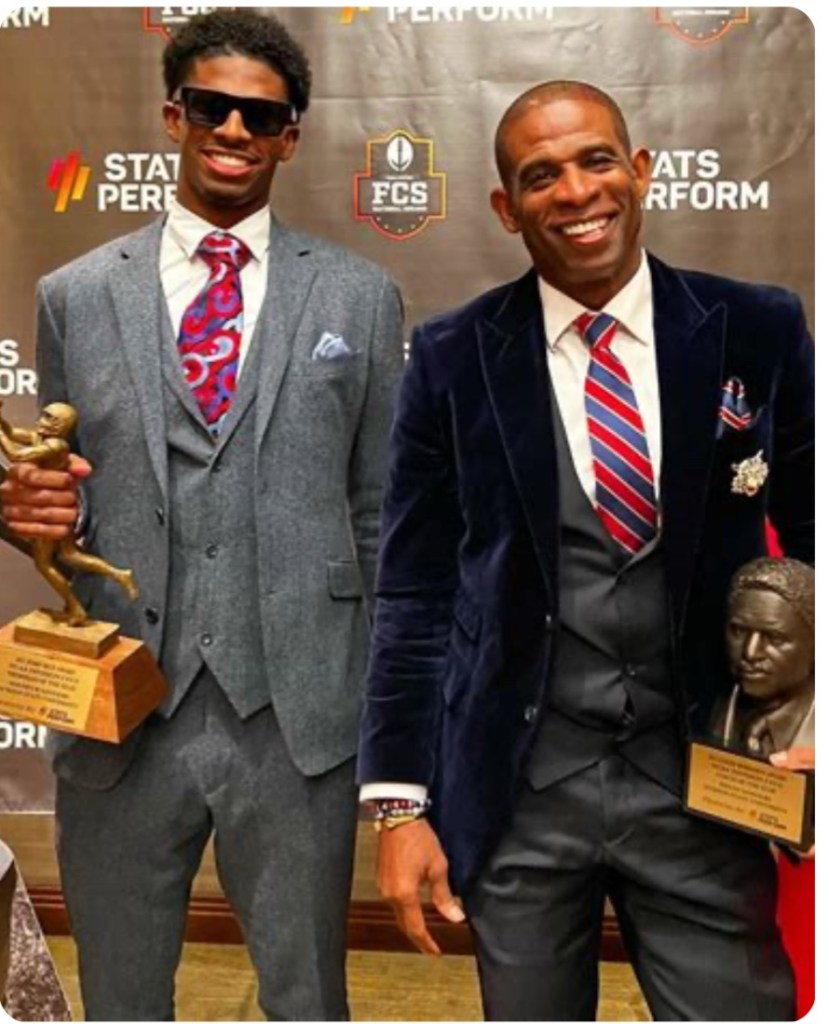
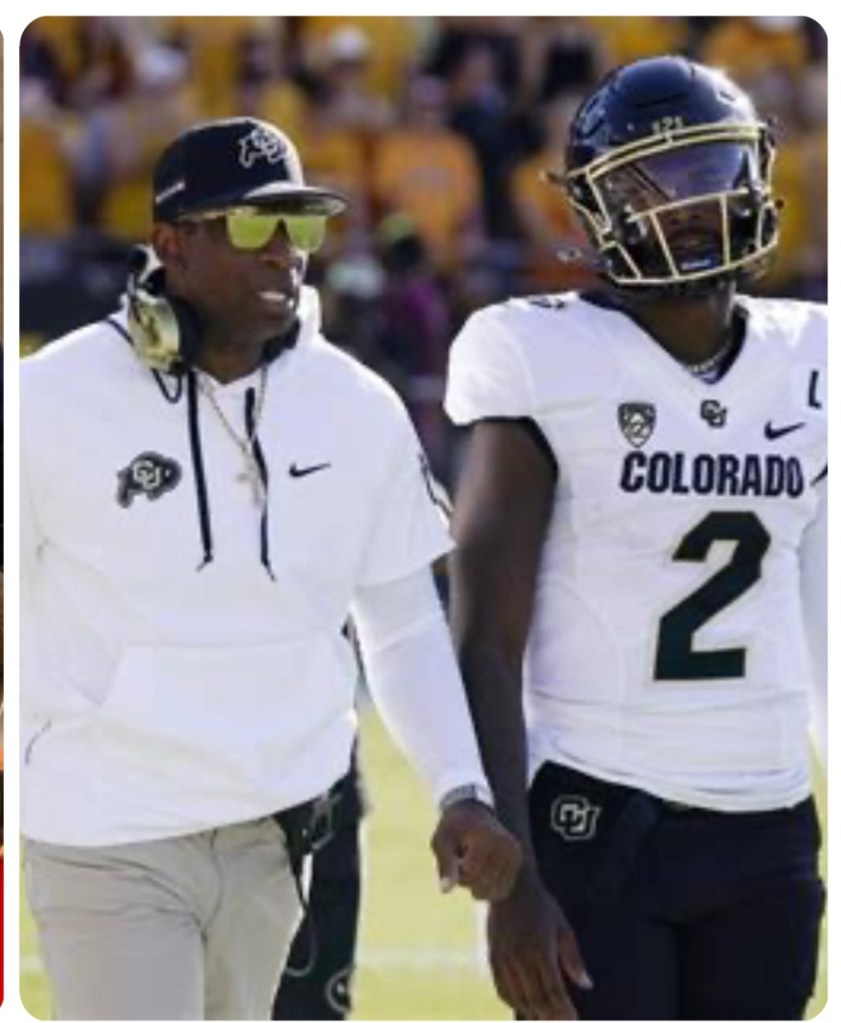
This is the question posed regarding the recent Shedeur Sanders’ NFL Draft issue. Read Part 1 to better understand this post.
In a hyper-competitive and image-sensitive world, things aren’t always fair.
From a fairness standpoint: absolutely not: a son should not be slighted because of the father. Shedeur Sanders (the son) is his own man, with his own talent, work ethic, and trajectory. However, we now know that the NFL is a hyper-competitive and image-sensitive world. In that world, things aren’t always fair.
Deion Sanders’ (the father) influence may have unintentionally worked against his son. Should that have happened at all?
Who is Deion Sanders (DS)?
I first heard of DS when he played for SF 49ers. He was there for only a year. But, according to records, that was his best season.
Click here (credits to Wikipedia) to read about the man, father, and coach.
Also, check out this interview prior to the Draft. The interviewer “nailed” him with his response. I wish he didn’t play into the interviewer’s manipulative question.
DS’s record speaks for itself. He’s not only seasoned, but equally conversant with the culture of the game and league. However,
- The NFL Allegedly Doesn’t Like “Unscripted Authority” nor the idea of a rookie dictating terms.
Deion’s charismatic, outspoken, and in-control personality came off to some front offices as “we call the shots.” Thus, leading to other concerns:
- Will Shedeur carry the same approach?
- Will the league be constantly navigating “Team Sanders”?
- The NFL’s Cultural Comfort Zone
The NFL is still heavily influenced by an old-school, conservative culture in its executive and ownership circles. They’re more comfortable with:
- Quiet, obedient leadership.
- Familiar pedigree (think Archie & Peyton Manning).
- Players and families who “play the game” the way the NFL expects.
If Shedeur had been the son of, say, Philip Rivers or Troy Aikman, and the father had voiced strong opinions about draft conditions or offensive line protection, it likely would’ve been chalked up to protective parenting or insider wisdom—not arrogance or entitlement.
- Concerns Over Coachability and Independence
Some insiders viewed Shedeur as an extension of Deion—a “package deal” of sorts. Even if Shedeur himself is coachable and grounded, teams might have worried:
- Will his father interfere if things go south?
- Will he prioritize the “Sanders brand” over the team’s needs?
This guilty-by-association is deeply flawed, but in a billion-dollar business where perception often outweighs reality, it’s said to be sadly common.
- The “Entitlement” Narrative
Because Shedeur was insulated under Deion’s leadership at Jackson State and Colorado, teams wondered whether he’d been “challenged” in ways NFL QBs must be. That is a fair concern. But again, if it were someone else, I’m sure the team would be willing to acculturate him.
Combine that with reports that the son seemed disinterested or dismissive in interviews, and the entitlement label grew legs—again, possibly unjustly—but it stuck.
[ I propose that the son was already pre-judged. As such, he was most likely misunderstood and/or wouldn’t have been able to scale through every hurdle posed before him].
- Racial and Cultural Double Standards
Let’s be direct: Deion is a proud, outspoken, and successful Black man. That rubs some people the wrong way. There’s a coded expectation for Black athletes and their families to be “grateful,” deferential, and quiet — especially when entering elite spaces. But, why so? Why give (or treat) some differently?
When a white father speaks out, it’s often viewed as strategic guidance or legacy insight. When Deion (or any successful black man) speaks, it’s seen by some as disruption or defiance — even when the message is similar. Double-standards of sorts.
- Legacy vs. Luggage
In NFL, the Manning family, the Matthews family, even the Bosa brothers—all legacies are seen as golden pipelines. No one questions their place, even when their NFL talent is comparable to others. They’re seen as assets from trusted stock.
With the Sanders family, however, some gatekeepers allegedly perceive their brand as baggage rather than pedigree. That’s a subtle but powerful difference — and it speaks volumes about whose “football royalty” is embraced and whose is policed.
- Media Framing and Spin
The media plays a huge role here too. If Deion were a different type of man—less brash, more behind-the-scenes—he might’ve been hailed as a “brilliant strategist” who shielded his son. But the narrative became “he overstepped,” perceived not as assertivene, but as insubordination. And that triggers institutional pushback.
If the dad had been someone like Eli Manning (who literally refused to play for the Chargers in 2004 and strong-armed his way to the Giants), the story would be painted as a savvy power move. But for Deion? It was cast as arrogance. Again, double standards. Yet, while some fathers and/or athletes would accept those standards, respect should be given to those who choose not to. But, instead, those are the ones who get axed the “who do you think you are” stance. Aren’t we all different and shouldn’t our differences be put into consideration?
- Some even alleged a collusion of sorts. 🤔
Nonetheless, the question remains:
Should This Have Happened?
No. A son shouldn’t be judged for his father’s words or fame —especially when the son has the tape, stats, leadership, and resilience to back up his worth.
And, how different is the Sanders’ issue compared to the NBA LeBron James and Bronny’s. The difference – the League.
Deion’s role as a father and coach is commendable. He’s invested, proud, and protective. But in this case, some believe he may have “overplayed the hand”— trying to preserve control.
[That’s the league’s alleged perceived narratives. Personally, I don’t think so.]
Merit doesn’t exist in a vacuum. The system must first be fair and equitable for all.
Bottom Line
Shedeur didn’t deserve the slide. But the NFL, like most elite organizations, doesn’t just scout talent—they evaluate risk, narrative, and public perception. Right or wrong, Deion’s larger-than-life personality seems to have made teams nervous. And unfortunately, Shedeur paid part of that price.
Shedeur might have fallen in the draft, but the real story is how American sports still measures people differently depending on who they are—and who they come from. The measures, sadly, are also not limited to the sports industry.
Yet we cry that racism is an outrageous excuse, that all things should be based on merit, and that DEI should be abolished. The denial of racism is, ironically, one of the clearest markers of its ongoing presence.
Meritocracy is a Goal, Not Reality
Should sports, jobs, education, etc. be based on merit? Absolutely. But we can’t ignore that merit doesn’t exist in a vacuum. The system must first be fair and equitable for all. When we see that Black and Brown individuals are still struggling to get their foot in the door—whether that’s in sports, in business, in politics or education —then we know the system isn’t fair, no matter how much we wish it were.
The “Meritocracy” Myth in the Real World
It’s easy for people to say “just work harder” when they haven’t faced the same challenges. When you’re born into a system where certain people are expected to succeed due to their race, class, or connections, it’s not really “merit” that determines outcomes—it’s access to opportunities and a network that actively seeks your success.
Think about it: Would we have even heard about Shedeur Sanders’ draft situation if his father wasn’t Deion Sanders, a former Hall of Famer? The sheer recognition of his last name seems to angst some. But if you strip away the legacy and just look at Shedeur’s performance, you see a young man who’s exceeded expectations at every level. So why was his draft status questioned more than, say, a white QB with a similar performance record?
This brings us to a hard truth: when the system is tilted, the playing field is never level, regardless of how “merit” is defined.
Meritocracy is a great ideal, but it’s one that needs a foundation of fairness and equity to actually be meaningful—and that’s the conversation we need to keep having.
Racism is Real, and It’s Insidious
Racism doesn’t just live in the past. It’s a structural issue, woven into the fabric of many systems. Acknowledging this doesn’t diminish anyone’s accomplishments. It’s simply an acknowledgment that the playing field has never been level, and in many cases, it still isn’t.
When someone denies the existence of racism, they’re usually looking at the world through a lens of their own privilege—whether it’s race, gender, or class. They might think of racism as overt actions like slurs or hate crimes. But racism isn’t always about explicit hate—it’s about opportunity and perception.
The uncomfortable reality is that even today, in 2025, many people are judged based on their skin color before their abilities are even considered. This isn’t just in sports—it’s in corporate America, in politics, in schools. It shows up in the hiring process, in how people are mentored, and in the professional opportunities they receive—or don’t receive.
What happened with Shedeur isn’t just about football. It’s a case study in how systemic bias still functions, not always through overt acts, but through gatekeeping, narrative control, and selective punishment.
Why Try to Censor Another Group?
At the core of censorship is a desire to maintain control—of narratives, norms, and power. When someone like Deion Sanders speaks boldly and unapologetically, especially in spaces historically dominated by white leadership, it becomes threatening.
It’s not just that Deion is outspoken—it’s that he refuses to ask for permission. That breaks the unspoken rule: “You can succeed, but do it quietly and on our terms.”
What Makes This Case Even More Striking is that;
- Shedeur didn’t get into trouble.
- He didn’t talk crazy.
- He’s academically strong, statistically elite, and mature.
And yet he was the one penalized. Why? Because of how others feel about his father’s unapologetic leadership. That’s not just unfair. That’s racialized gatekeeping.
The Sanders Story Taps a Deeper Nerve
It exposes a raw truth that despite all your accomplishments, you might still represent a threat, not an achievement. That’s the part many don’t want to admit.
They’d rather say:
• “It’s about football.”
• “It’s about fit.”
• “It’s about team culture.”
But behind those coded phrases is discomfort with seeing people succeed without bowing to the usual rules.
That’s a heavy, mixed signal. But it also offers a chance for a bigger conversation.
The Teachable Moment
• Yes, the system has flaws. But we won’t let it discourage us.
• You can’t control people’s bias, but you can control you.
• Visibility comes with a price—but also with power. Be strategic, not silent.
• Be yourself; everyone else is taken.
Being excellent in your field seems to be no longer enough. How do you/we move through spaces that may not fully welcome you/us?
That’s not fair—but it is real. And by studying what happened to Shedeur, we all either as parents or sons and daughters, and particularly young athletes, can begin learning how to protect without shrinking ourselves.
I pray that Shedeur has an exceptional first year with the Cleveland Browns, without kissing the ring, and becomes a blueprint. A walking case study in how one can succeed in the system without becoming a product of the system.
And if that happens? The gatekeepers will have to reckon with a new kind of access: one they can’t ignore, silence, or own.
◦
 Think-Talk