I have wanted to do a comparison of oil marketing companies for a long time now, but other topics have pushed it back until now. A recent incident finally prompted the overdue post.
My regulars are Chevron, Shell, Mobil, Costco, 76, or Arco andI know the effect of each on my car.
My Recent Incident
There is a Mobil gas station round the corner from the beach where I normally go for a walk. I went there last Friday and was surprised to see a new sign/logo and name, but still the same colors. I did a double-take; somewhat confused. As I was about to retreat into my car, a man walked out and we had this conversation;
Man: “we changed the name.”
Me: “when?”
Man: “two days ago. I was in contract with them for ten years; now I can buy gas from anywhere.”
Me: “Nice. So, where did you buy this gas from?”
Without batting an eyelid:
Man: “Chevron.”
The pump prices were lower than what they used to be. But, I had no reason to doubt him. So, I filled up my tank. As I was doing so, I thought “he must have such a high volume to be able to sell Chevron gas at such low prices.”
Well, lo and behold, my car drove differently. If I was able to suck out the gas, I would have done so the next day. I was afraid that the engine would knock out. Long and short is that I do not think the man got that gas from Chevron and I won’t be returning there anymore.
I don’t buy from just any gas station. My regulars are Chevron, Shell, Mobil, Costco, 76, or Arco and I know the effect of each on my car as far as driving is concerned.
How about you – are you one who buys gas from any gas station? Do you care about what you’re feeding your car or price is the primary factor? Drop a comment to share your thoughts.
What do you feed your Car?
When you pull up to the pump, price might be the first thing on your mind (it actually used to be for me) — but what about what’s actually going into your car? Not all gas is created equal. Just like what we feed our bodies. The right fuel can extend your engine’s life, improve fuel efficiency, and even help your car run smoother. Some companies invest heavily in research and additives. Others? Not so much.
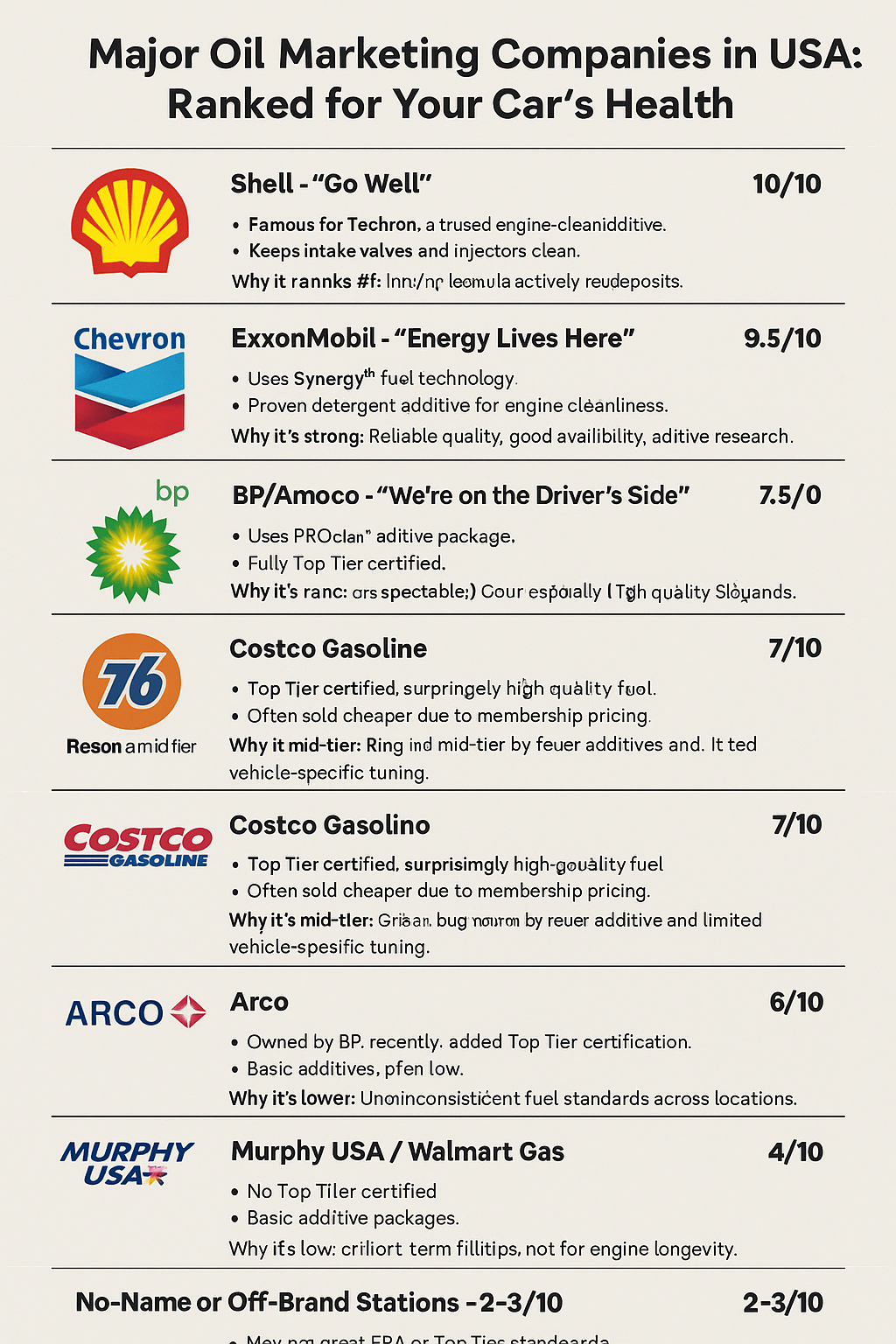
Let’s review a list of the major gasoline brands in the U.S. , their slogans, and how they rank based on fuel quality, engine care, cleanliness, additive technology, customer experience, and real-world car performance. (10 = best for your car; 1 = worst)
- Shell
• Slogan: “Go Well”
• Rating: 10/10
• Uses V-Power NiTRO+:
• Excellent engine
• Global research-backed fuel.
• Why It’s Best: Shell’s V-Power NiTRO+ is one of the strongest additive packages on the market, a premium blend that fights gunk, corrosion, and wear. It’s consistently rated among the best for engine health, cleaning and friction reduction. It is used in many automaker tests.
Why it ranks #1: Industry-leading formula that actively removes deposits and their stations are widely available.
- Chevron (with Techron)
• Slogan: “Expect More”
• Rating: 9.5/10
• Highlight: Techron is a powerful additive known for keeping fuel injectors and valves squeaky clean. Great for performance and fuel economy.
Why slightly below Shell: Equally strong, but Shell’s additive slightly outperforms in lab and road tests.
- ExxonMobil
• Slogan: “Energy Lives Here”
• Rating: 9/10
• Highlight: Mobil fuels use Synergy™ fuel technology for better combustion and cleaning. Pair it with Mobil 1 synthetic oil, and your engine is in great hands.
Why it’s strong: Reliable quality, good availability, strong additive research.
- BP (British Petroleum)/Amoco
• Slogan: “Beyond Petroleum”
Rating: 8.5/10
• Uses Invigorate® additives.
• Helps fight engine dirt and corrosion.
Why it’s solid: Clean fuel standard meets Top Tier specs; not as high-performing as Shell/Chevron.
- 76 – “We’re on the Driver’s Side”
• Rating: 8/10
• Uses PROclean™ additive package.
• Fully Top Tier certified.
Why it’s respectable: Good for your car, especially if you’re West Coast-based. Slightly behind on cleaning power compared to leaders.
- Phillips 66 / Conoco
• Slogan: “Live to the Full”
• Rating: 8/10
• Highlight: Quietly dependable with Top Tier content offerings at many locations.
- Costco Gasoline
• Slogan: (Unofficial) “High Quality. Low Prices.”
• Rating: 7.5/10
• Surprisingly high-quality fuel.
• Highlight: Top Tier certified, and incredibly fresh due to high volume. Excellent value. Often sold cheaper due to membership pricing without sacrificing quality.
Why it’s ranked mid-tier: Great quality, limited by fewer additives and limited vehicle-specific tuning.
- QuikTrip (QT)
• Slogan: “More Than a Gas Station”
• Rating: 7.5/10
• Highlight: QT gas is Top Tier, stations are clean, and performance is consistent. A sleeper pick for fuel quality.
- Valero
• Slogan: “The Power of People”
• Rating: 7/10
• Highlight: Many Valero stations offer Top Tier gas. A dependable option for everyday drivers.
• Not consistently Top Tier, though some locations carry quality fuel.
• Often price-competitive.
Why it ranks lower: Inconsistent fuel standards across locations.
- Buc-ee’s
• Slogan: “Cleanest Restrooms in America”
• Rating: 7/10
• Highlight: Famous for brisket, but its gas is well-managed and fresh. Not Top Tier certified, but still quality.
- Love’s Travel Stops
• Slogan: “Clean Places, Friendly Faces”
• Rating: 7/10
• Highlight: Great for long-haul travelers and RVs. Fuel is consistent, even if not always premium.
- ARCO
• Slogan: “Quality TOP TIER™ Gas for Less”
• Rating: 6.5/10
• Owned by BP; recently added Top Tier certification.
• Highlight: Budget-friendly and Top Tier certified. Can’t beat the price, but some report slightly lower MPG.
• Basic additives, but still meets high standards.
Why it’s budget-friendly: Good for regular cars, but not the best for performance or long-term buildup.
- RaceTrac / RaceWay
• Slogan: “Whatever Gets You Going”
• Rating: 6.5/10
• Highlight: Not always Top Tier, but solid enough for everyday use when you’re not picky.
- Pilot Flying J
• Slogan: “Fueling Life’s Journeys”
• Rating: 6.5/10
• Highlight: Focused on truckers and road warriors. Average gas quality, excellent stop for amenities.
- CITGO
• Slogan: “Fueling Good”
• Rating: 6/10
• Highlight: Reasonable quality, but not all locations meet Top Tier standards.
- Sam’s Club / Murphy USA /Walmart Gas
• Slogan: “Save Money. Live Better.”
• Rating: 4/10
• Not Top Tier certified.
• Very basic additive packages.
• Highlight: Budget-first option. Some stations offer Top Tier fuel, others don’t. Use with caution.
Why it’s low: Good for short-term fill-ups, but not ideal for engine longevity.
- Kroger / Fred Meyer / Smith’s
• Slogan: “Fresh for Everyone”
• Rating: 6/10
• Highlight: Discounts tied to grocery shopping. Fuel quality varies based on supplier.
- Circle K
• Slogan: “Take It Easy”
• Rating: 6/10
• Highlight: Some locations sell branded, Top Tier fuel—but inconsistency is a concern.
- 7-Eleven Fuel
• Slogan: “Oh thank heaven for 7-Eleven”
• Rating: 5.5/10
• Highlight: After acquiring Speedway, some stations now offer Top Tier gas—but not across the board.
- Sunoco
• Slogan: “Fuels Your Best”
• Rating: 5.5/10
• Highlight: Known more for race fuel than everyday quality. Regular gas varies widely in performance.
- Murphy USA
• Slogan: “Low Prices. Friendly Service. Always.”
• Rating: 5/10
• Highlight: Cheap and available—but performance-wise, best used occasionally rather than regularly.
- No-Name or Off-Brand Stations
• Rating: 2–3/10
• May not meet EPA or Top Tier standards.
• Additives vary or are completely missing.
Why it’s risky: Cheaper gas could lead to carbon deposits and poor performance.
Final Thoughts: What’s Best for Your Car?
• Best for Performance: Shell, Chevron, ExxonMobil
• Best for Value: Costco, ARCO, QuikTrip
• Best for Convenience: Love’s, Buc-ee’s, 7-Eleven
If your car is your baby (or just your daily warrior), spending a few cents more per gallon on Top Tier gasoline is almost always worth it. Cleaner engines, better MPG, and fewer trips to the mechanic.
Shell vs. Chevron: Which Gas is Better for Your Car?
When it comes to premium gas, Shell and Chevron are two of the biggest names at the pump—but which one actually gives your car more bang for your buck
Shell – “Go Well”
• Additive: V-Power NiTRO+
• Known For: Aggressive engine cleaning, anti-friction technology, corrosion protection.
• Pros: Excellent at keeping fuel injectors and valves clean; backed by Ferrari and BMW in global testing.
• Bonus: Widely available and often a few cents cheaper than Chevron.
Chevron – “Expect More”
• Additive: Techron
• Known For: Deep-cleaning detergent, trusted by mechanics.
• Pros: Reduces carbon deposits over time, good for older engines.
• Bonus: Strong presence on the West Coast, great for high-mileage vehicles.
Verdict
Shell takes the win for slightly stronger engine protection and better value across more regions. But if Chevron’s your go-to, you’re still in good hands—just at a premium.
Bottom line: Both are Top Tier fuels and excellent choices. If you’re focused on max engine health and a cleaner ride, Shell may give you that extra edge.
What Is Top Tier Gasoline—and Why Should You Care?
You’ve probably seen the “Top Tier” sticker at gas stations, but what does it actually mean?
Top Tier gasoline is a higher standard of fuel, backed by major automakers like BMW, Toyota, Honda, and General Motors. It goes beyond basic EPA requirements by including enhanced detergent additives that keep your engine cleaner and running more efficiently.
Why It Matters:
• Cleans your engine: Prevents carbon buildup on injectors and valves.
• Improves performance: Keeps your car running smoother, especially over time.
• Better mileage: A clean engine burns fuel more efficiently.
• Protects your investment: Prolongs engine life and reduces repair costs.
Not All Gas is Top Tier
Many budget or off-brand stations don’t meet this standard. So even if the gas is cheaper upfront, it could cost more down the road.
Look for the Top Tier logo at the pump—it’s your car’s version of eating clean.
What Should You Really Consider When “Feeding” Your Car?
We all do it: pull into a gas station, squint at the price signs, and gravitate toward the cheapest pump. But when it comes to fueling your car, price shouldn’t always be the first or only consideration. Here’s what drivers should keep in mind:
- Is It Top Tier Certified?
Top Tier gas meets a higher standard for detergent additives that keep your engine clean. Over time, this means:
• Better fuel efficiency
• Fewer deposits on fuel injectors
• Less engine knocking or hesitation
Look for the Top Tier sticker at the pump. It’s worth the few extra cents per gallon.
- Your Car’s Engine Type
• Luxury, turbocharged, or high-performance cars often require premium gas. Using regular fuel could damage the engine or reduce performance.
• Everyday sedans or crossovers run fine on regular—but even then, better-quality gas can extend engine life. - Additive Packages Matter
Companies like Shell (V-Power) and Chevron (Techron) invest in advanced fuel additives. These don’t just clean your engine—they protect it. Cheaper gas from unknown stations often skips these, which can lead to carbon buildup over time.
- How Often You Drive
If you only drive short distances once a week, low-quality fuel may not do much harm. But for daily commuters, road trippers, and delivery drivers, using clean, quality fuel is like giving your engine a healthy diet.
- Fuel Economy vs. Fuel Price
Low-grade gas may cost less now, but if it causes your car to burn more fuel or run less efficiently, you’re actually paying more in the long run.
Bottom Line:
Think of gasoline like food for your engine. Sure, fast food is cheaper—but would you eat it every day and expect to feel your best? Your car is no different.
 Think-Talk