Great question — and the short answer is: the ideal is to work both hard and smart. You don’t have to choose one over the other. But understanding the difference between them helps you maximize your time, energy, and results.
🔍 What’s the Difference?
🛠️ Working Hard
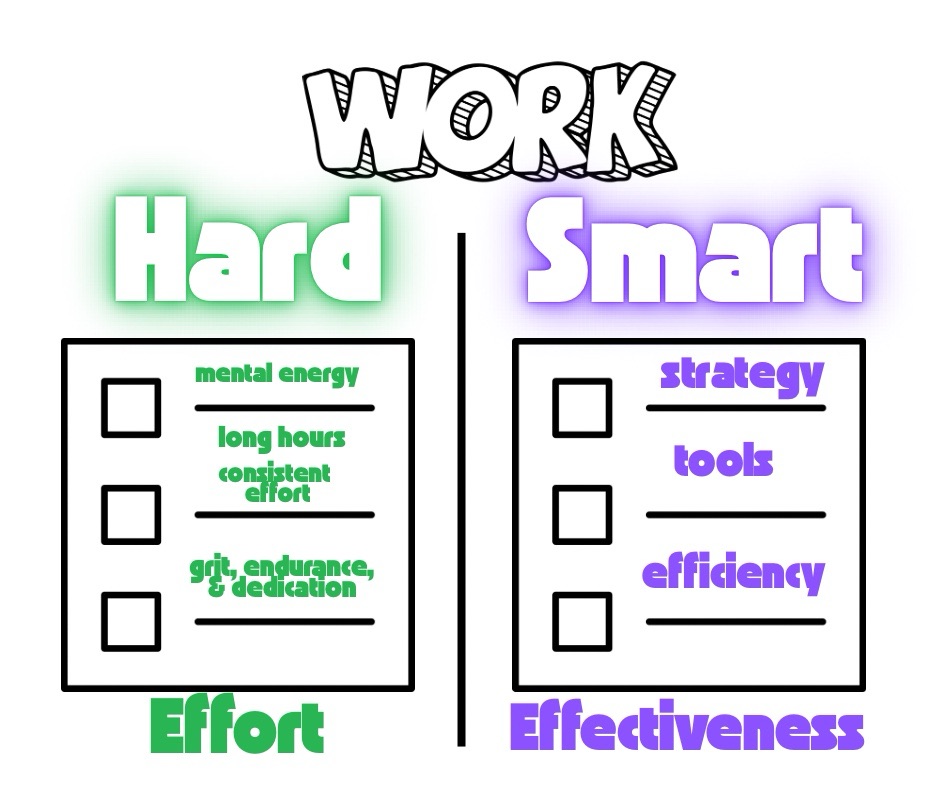
Means putting in long hours, consistent effort, and physical or mental energy. It’s about grit, endurance, and dedication.
• Example: Manually entering 500 email addresses into a spreadsheet.
• Traits: Diligence, persistence, stamina.
🧠 Working Smart
Is about using strategy, tools, and efficiency to get better results with less wasted effort.
• Example: Using a script or tool to automatically import those 500 emails.
• Traits: Resourcefulness, innovation, systems-thinking.
🧩 How They Complement Each Other
• Working smart without effort may lead to inconsistent or lazy execution.
• Working hard without strategy may lead to burnout and wasted effort.
Together, they give you the edge:
Smart planning + hard execution = exponential results.
🏁 A Real-Life Analogy
Think of building a house:
• Working hard is lifting bricks and hammering nails all day.
• Working smart is reading the blueprint first, using power tools, and organizing your crew efficiently.
Both are required to build something strong and on time.
💡 Bottom Line
• Work hard = effort.
• Work smart = effectiveness.
✔️ The winning combo?
Be relentless in your effort and wise in your approach.
💣 What Do You Call It?
- Overworking / Burnout Culture
Working too hard without rest or boundaries. It’s unsustainable and leads to physical, emotional, and mental exhaustion.
- Survival Hustle
This is different from ambition. It’s when someone juggles 2–3 jobs not for luxury or advancement, but because basic needs aren’t met otherwise. It’s not pride — it’s survival.
- Toxic Productivity
When someone is constantly busy, and begins to equate self-worth with output. They feel guilty resting, even though they need to.
- Functional Desperation
This is when people are functioning and even “getting things done,” but it’s driven by financial pressure, not fulfillment. Like they’re living in “go mode” with no off switch.
🧾 “The Bills Got to Be Paid!”
Yes — and that’s a valid point. It’s the reality for many. But here’s the problem:
If you’re constantly working just to survive, without pause or margin, you’re slowly losing your health, joy, and sometimes even relationships — just to keep the lights on.
🧠 So What’s the Answer?
There’s no quick fix, but here are a few thoughts:
• Acknowledge the season – Sometimes we hustle because we have to, not because we want to. That’s okay. But it shouldn’t be permanent.
• Set a plan – Even if you’re juggling multiple jobs now, begin to think: What skills or systems can I invest in so I don’t have to hustle this hard forever?
• Rest is not a luxury; it’s maintenance – Skipping rest may help short-term, but it costs long-term — in poor health, broken relationships, or lost purpose.
🧩 A Real Talk
“Yes, the bills gotta be paid. But so does your body, your peace, your time, and your soul. Don’t just survive — strategize.”
🐀 The Rat Race: When Working Hard Becomes a Trap
Why Overworking Isn’t a Way of Life—And How to Get Out
We’ve all heard the line: “The bills gotta be paid.”
And it’s true. Rent isn’t waiting. Groceries don’t grow on the kitchen counter. But for many, what starts as a temporary hustle quietly morphs into a lifestyle of constant grind, multiple jobs, no rest, and little to no time for loved ones—or even themselves.
Welcome to the rat race.
🐭 What Is the Rat Race?
Popularized by Robert Kiyosaki in Rich Dad Poor Dad, the “rat race” is the endless loop of working harder just to stay afloat. It’s that cycle where you work 2 or 3 jobs, not because you’re thriving—but just to survive. More money comes in, more bills go out, and the finish line never seems to move.
You run harder, but the wheel spins faster—and you’re still in the same cage.
🔥 The Warning Signs You’re in the Rat Race
• You constantly say “yes” to extra shifts out of fear, not choice.
• Rest feels like a luxury you can’t afford.
• You’re physically present at home, but emotionally and mentally unavailable.
• You don’t know what joy feels like anymore—just “obligations.”
😔 But What’s the Alternative? “The bills don’t pay themselves.”
That’s the hard part. Many aren’t overworking because they’re greedy. They’re hustling because they feel they have no other option.
But here’s the truth:
Yes, the bills need to be paid—but not at the cost of your health, peace, and purpose.
If you die trying to pay off the light bill, the lights will stay on—but you won’t.
✨ How to Escape the Rat Race
Here are a few steps—not quick fixes—but intentional pivots to help you get out:
- Name It to Break It
Recognize that your current hustle is a season, not a lifestyle.
If you’re working multiple jobs with no end in sight, say it out loud:
“I’m in the rat race. And I don’t want to live like this forever.”
Clarity is the first step to change.
- Create a Long-Term Vision
Ask yourself:
• What kind of life do I want in 5 years?
• Do I want more freedom or just a fatter paycheck?
• What do I need to start doing now to create that life?
The rat race blinds you with short-term survival.
Vision gives you direction beyond just working to pay bills.
- Upgrade Your Skills, Not Your Schedule
Instead of picking up a third job, consider:
• Taking a free online course (Google, Coursera, Udemy).
• Learning high-demand remote skills (copywriting, digital marketing, coding, bookkeeping).
• Getting certified in trades that pay more (electrician, HVAC, project management).
More skills = more value = better income with less time spent working.
- Cut Back to Move Forward
Sometimes the exit door isn’t about earning more—it’s about spending less.
• Audit your subscriptions and bills.
• Downsize temporarily to reduce financial pressure.
• Delay non-essential purchases.
You can’t win the rat race with a “keep-up” mentality.
Sometimes, going lean is the smartest move.
- Start a Side Project with Long-Term Gain
You may be tired, but ask: “What could I build slowly, over time, that might one day free me?”
That might be:
• A blog
• An Etsy store
• Freelancing on the side
• A YouTube channel
• Writing a book
It may not pay now, but it could eventually shift you from wage-earner to wealth-builder.
- Prioritize Rest Like It’s Revenue
Rest doesn’t make you lazy—it makes you last.
Start with:
• One day a week where you don’t check emails or work.
• Short, scheduled moments of reflection or journaling.
• Sleep hygiene (because tired people make poor money decisions).
Burnout doesn’t whisper—it ambushes you. Rest before life forces you to.
🛑 Final Thoughts:
The rat race is real. But it’s not mandatory.
Many of us were handed this hustle mentality without a plan for peace. But we can unlearn it. We can shift from survival to strategy, from burnout to balance, from paycheck-to-paycheck to purpose.
“Yes, the bills gotta be paid. But not with your soul.”
 Think-Talk