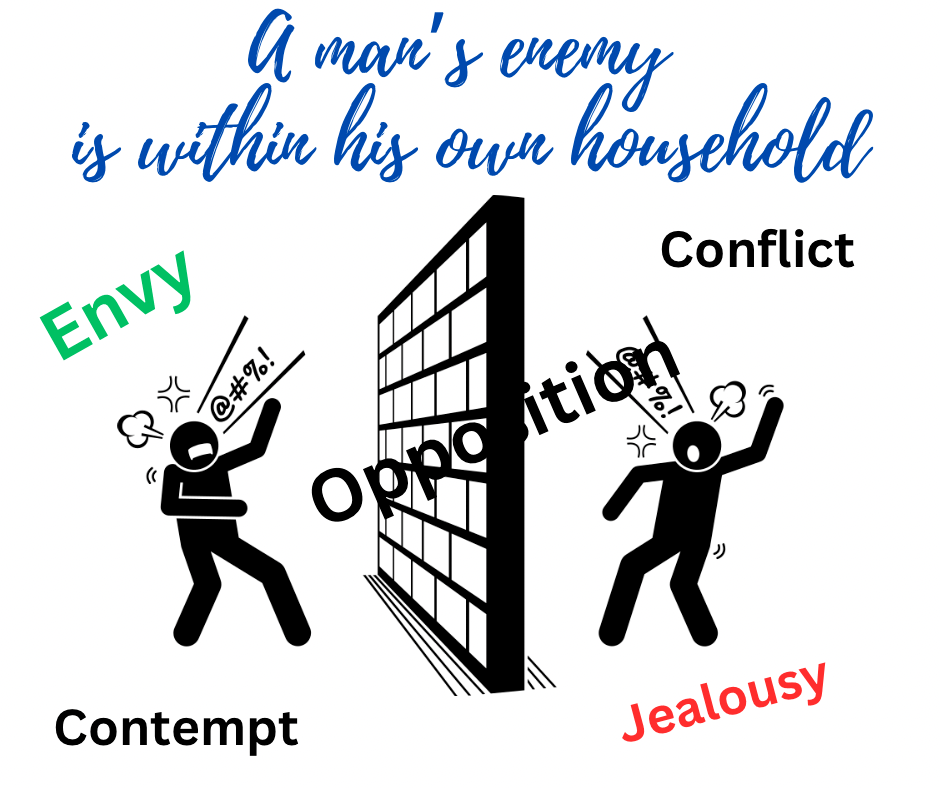
“A man’s enemies will be the members of his own household.”
— Matthew 10:36 (NIV)
The above scripture, on which this post is based, is a piercing truth — one that stings more deeply than betrayal from a stranger ever could.
It’s one thing to face opposition from the world, but when the resistance comes from your own bloodline, your inner circle, or your closest community — it cuts deep.
The idea that those closest to us — our family members, our people — could become our enemies sounds unsettling, even offensive. Yet, these were Jesus’ very words, quoting the prophet Micah (Micah 7:6).
Jesus wasn’t being dramatic when He said this. He was issuing a sobering truth: that the most unexpected and painful opposition can come not from strangers, but from those who know and love us — or should.
Why would Jesus say this? What does it mean? And why does it still ring true today?
The Context: Not a Call for Division, but a Warning About It
Jesus was preparing His disciples for the cost of following Him. In Matthew 10, He wasn’t preaching peace and harmony at any cost, but rather truth at any cost — even the cost of family ties. He warned that His message of repentance and righteousness would not be welcomed by all. In fact, it would cause deep rifts, even between father and son, mother and daughter, siblings, and spouses.
“For I have come to turn a man against his father, a daughter against her mother…”
— Matthew 10:35
This isn’t to say that Jesus intended to sow division, but rather to highlight the cost of standing for what is right, true, and eternal. When your convictions are God-aligned, those who oppose God — even if they share your blood — may resist you, resent you, or even betray you.
Why Is the Enemy Often ‘Within’?
1. Proximity Breeds Conflict
We live with family, grow up with them, eat with them, share space, decisions, and sometimes even dreams. They know our habits, our flaws, and our past. Conflict naturally arises where closeness exists. Minor differences can escalate into major disagreements when you’re in constant proximity. When transformation happens in us — particularly spiritual — it challenges their comfort zone. They may feel judged or threatened, even if we never say a word.
2. Familiarity Can Breed Contempt
Jesus Himself experienced this:
“A prophet is not without honor except in his own town and in his own home.”
— Matthew 13:57
Those who “knew you when” may have the hardest time accepting the new you. Your growth, faith, or calling may be dismissed, mocked, or opposed — simply because they see you through the lens of the past.
Those who watched you grow up may struggle to honor the person you’ve become — especially if you now carry spiritual authority, new convictions, or a God-given calling.
“Isn’t this the carpenter’s son?”
— Matthew 13:55
3. Shared History Doesn’t Mean Shared Destiny
Just because you’re related by blood or culture doesn’t mean you’re walking the same spiritual path. The enemy doesn’t always need to attack from the outside — sometimes, resistance comes from those most familiar with your history but not aligned with your future.
- Jealousy Is Rooted in Comparison
Family and friends often compare your success, calling, or blessings with their own. Instead of celebrating you, jealousy sets in — sometimes subconsciously — and resentment builds.
- Generational Patterns Are Being Challenged
When you rise to break cycles — addiction, poverty, shame, compromise, unbelief — you automatically become a disruptor. Those comfortable in dysfunction may feel threatened or offended by your deliverance.
- Spiritual Warfare Targets Relationships Closest to You
The enemy knows that a divided home is a weakened force. So he sows seeds of offense, distrust, and bitterness within households to fracture unity. It’s strategic — not accidental.
Biblical Examples of ‘Household’ Enemies
• Joseph and His Brothers: Jealousy and Envy over Joseph’s dreams and favor from their father drove his brothers to sell him into slavery. The betrayal came not from outsiders but from his own kin and it nearly ended Joseph’s life.
• David and Saul: David became Saul’s family through marriage to Saul’s daughter and served in his house. But Saul’s jealousy led him to pursue David’s life, despite David’s loyalty. Saul saw David’s anointing as a threat. Still, envy turned Saul into David’s greatest enemy.
• Jesus and His Own Family: Even Jesus’ siblings didn’t initially believe in Him (John 7:5). Their familiarity made it hard to accept His divine mission. and His hometown rejected Him.
- Cain and Abel (Genesis 4)
In the first recorded sibling relationship, Cain killed Abel out of jealousy — not a stranger, but his own brother, in cold blood.
- Miriam and Aaron vs. Moses (Numbers 12)
Moses’ own sister and brother challenged his leadership, driven by pride and jealousy, questioning his authority and personal decisions.
Modern-Day Manifestations
- You step into a new level of faith — and your spouse mocks you.
- You break generational curses — and your parents or siblings misunderstand you.
- You leave behind toxic traditions — and your community labels you as proud or rebellious.
- You finally pursue your purpose — and “your own people” try to pull you back to the familiar.
How Should We Respond?
1. With Wisdom, Not Retaliation
You’re not called to fight your household. Don’t stoop to pettiness or revenge. Stand firm in truth. Love them. Be discerning. Speak when necessary, but never compromise your calling to “clap back.”
2. With Prayer, Not Bitterness
Bitterness is a poison that contaminates your spirit. Pray for clarity, peace, and even for your opposers or those who misunderstand you, to be healed and enlightened. The enemy might be using them, but they are not your true enemy — he is (Ephesians 6:12).
3. With Perseverance, Not Isolation
You may feel tempted to withdraw completely. While some distance may be healthy, don’t retreat into silence or give up on your assignment. Stay the course. God is watching.. Keep being a light — even when the ones closest to you don’t want to see it yet. Often, it is your consistency and humility that wins them over in time.
4. With Boundaries, Not Hatred
Jesus loved deeply, but He wasn’t afraid to walk away from those who tried to hinder His mission. He walked away when He needed to — not out of spite, but strategy. Boundaries protect your peace without cutting off love. It’s okay to set boundaries, even with family.
- With Identity, Not Insecurity
Know who you are in Christ. When family or close ones question your worth or calling, root yourself deeper in your God-given identity. You’re not who they say you are — you are who He says you are.
The cost of discipleship is paid in the currency of strained relationships.
Final Thoughts
If you’re experiencing this kind of internal opposition, know that you’re not alone.
Jesus never sugarcoated the cost of following Him. He knew it well that truth divides, and righteousness offends. But He also promised that those who endure will be rewarded. If your obedience to God has stirred resistance within your own household or community, take heart. You’re in good company — and in God’s hands.
God sees your stance, honors your obedience, and will fight for you.
“When my father and my mother forsake me, then the Lord will take me up.”
— Psalm 27:10
Sometimes, sadly, the cost of discipleship is paid in the currency of strained relationships. But don’t despair — the reward of remaining faithful is far greater than the pain of being misunderstood.
So, stay rooted. Keep walking in truth and love. Let your light shine — even if it exposes darkness in those closest to you. Sometimes, it’s that very light that will lead them back to God.
 Think-Talk