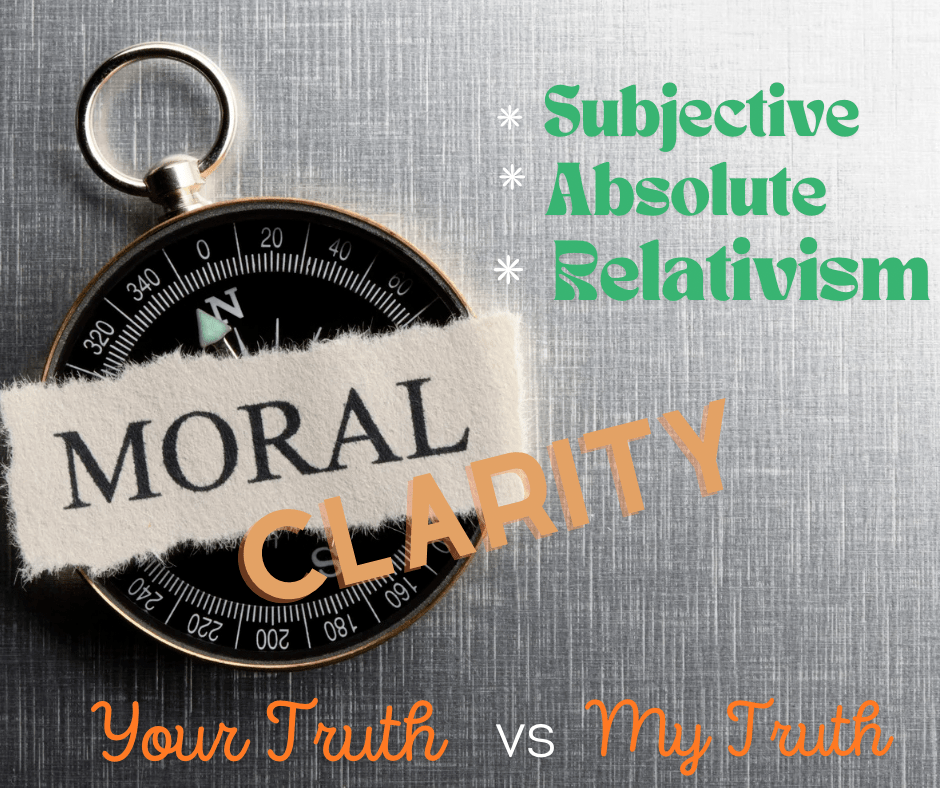
Moral Clarity in a Subjective World
We are now in an age where moral clarity is seen as offensive — because if I say something is objectively wrong, it implies someone else is objectively wrong too. And that’s uncomfortable. So society often leans toward moral relativism — the belief that morality depends on the individual or the culture. “What’s right for you may not be right for me.”
This is where the conversation about absolute truth vs. subjective truth comes in.
Subjective Truth: Rooted in Experience
Subjective truth is based on personal beliefs, emotions, culture, or perspective.
Subjective truth is based on personal beliefs, emotions, culture, or perspective. For example:
- You might say, “It’s wrong to eat meat.”
- I might say, “It’s completely fine to eat meat — in fact, necessary.”
Both are true to each person, but these are subjective truths. They’re shaped by personal experience, upbringing, preferences, or even trauma. These truths matter — but they are not always universal or applicable to all.
Absolute Truth: Rooted in Objective Reality
Absolute truth is constant and unchanging — whether or not anyone believes it.
Absolute truth, on the other hand, is constant and unchanging — whether or not anyone believes it. For example:
- “Murdering an innocent person (or any person) is wrong.”
- “Stealing violates another’s right to property.”
These are moral absolutes. They exist across cultures and time periods, and most people (regardless of religion or worldview) acknowledge them — even if they differ on the application.
But what happens when people begin to redefine morality according to their feelings, or dismiss absolute standards entirely?
Examples of Redefining Morality
- Is it okay to steal to satisfy hunger or need?
The short answer is “No, it’s not okay — but it is understandable.”
The longer thought, however, is that the act of stealing is still wrong (it violates someone else’s property), but when it’s done out of desperation rather than greed, we often respond with compassion, not condemnation. Society — and even scripture — makes room for nuance.
In Proverbs 6:30-31, it says:
“People do not despise a thief if he steals to satisfy his hunger when he is starving. Yet if he is caught, he must pay sevenfold…”
This means:
- The moral standard (absolute truth) still calls it stealing — it’s not redefined.
- But there’s a merciful understanding of why it happened.
- Justice may require restitution, but not necessarily harsh punishment.
Even legal systems today acknowledge this through concepts like “mitigating circumstances” and often show leniency in such cases. That’s not moral relativism — that’s applying justice with mercy.
Bottom line: Stealing doesn’t become “right” just because the motive is understandable. It remains a moral wrong, even if we approach it with empathy.
- Does religious belief (e.g. marrying underage girls) shape or justify absolute truth?
This dives into a deep and often controversial intersection of religion, culture, and moral philosophy.
In the cultures and religions, that permit men to marry very young girls, we must ask:
- Is it culturally accepted? In some places, yes.
- Is it religiously justified? Interpretations vary.
- Is it morally right? That’s where absolute truth must step in.
There is a tension:
- Subjective truth: “Our tradition permits this, and we believe it is right.”
- Cultural norm: “This is how it has always been done in our society.”
- Absolute moral truth: “It is wrong to exploit, endanger, or harm a child — regardless of culture or religion.”
When religious practices violate human dignity, safety, or consent, they cannot be excused by culture or tradition. That’s where universal moral truths must be upheld — especially to protect the vulnerable.
Bottom line: Practices like marrying underage girls may be culturally normalized but morally unjustifiable. That falls under misapplied subjective truth, not absolute truth. True morality upholds dignity, maturity, and choice.
- Atheists and agnostics do not believe that God exists. If God doesn’t exist, there can be no absolute truth.
This is a profound and ancient debate — and yet, many philosophers agree that:
Without a higher power (God), there is no ultimate source for absolute truth.
Let’s unpack it:
If God exists, then:
- Truth has an origin beyond human opinion.
- Morality is grounded in God’s nature — holy, just, loving.
- Good and evil have objective meaning.
If God does not exist, then:
- Morality is just preference or social agreement.
- Truth becomes fluid, relative to the strongest voice or majority.
- There is no ultimate accountability — only power and consequence.
“If God does not exist, everything is permissible.”
– Fyodor Dostoevsky
Yet, even atheists tend to live as if some moral absolutes exist. They still cry out against injustice, oppression, and cruelty. Why? Because we are all wired with a sense of right and wrong — what the Bible calls “the law written on the heart” (Romans 2:15).
Bottom line: While some try to construct moral frameworks without God, those frameworks are ultimately fragile and often inconsistent. True absolute truth finds its grounding in a divine moral lawgiver.
But moral relativism breaks down when faced with real evil:
- Can we say child abuse is wrong only in some cultures
- Was slavery only wrong when someone felt it was wrong?
If we go by “your truth” and “my truth” without acknowledging a higher standard, chaos follows.
So, Do We Have Absolute Truth?
Yes. And without it, society loses its moral compass.
From a Christian worldview, truth originates from God — not from the shifting sands of human opinion. Jesus didn’t say, “I’ll show you a truth” — He said, “I am the way, the truth, and the life.” (John 14:6). That is bold. It’s not relative; it’s absolute.
Likewise, scripture teaches that the law of God is written on the human heart (Romans 2:15) — meaning, we all have an internal compass that resonates with certain absolute truths. We may silence it. We may suppress it. But it’s there.
When Truths Collide, How Do We Decide?
When “your truth” and “my truth” are in tension:
- We seek the higher truth — the one that can stand the test of time, logic, and morality.
- We ask: Does this truth protect life, justice, love, and dignity? And,
- We examine: Is it true for all people, in all places, at all times?
call wrong what it is, even when it’s uncomfortable
Because when truth is only based on opinion, the one with the loudest voice — or the most power — wins. But when truth is rooted in something higher, we all submit to the same standard.
There’s a place for compassion, which is not the same as compromise.
There’s a place for context. But there must also be a place for conviction — for calling wrong what it is, even when it’s uncomfortable.
Culture is not the same as morality. And doubt doesn’t erase divine reality.
There’s nothing wrong with acknowledging personal truths — your lived experience matters. But we must never let personal truth override moral clarity. And that clarity, more often than not, comes from absolute truth, not subjective opinion.
“Your truth” and “My truth” aren’t always enough — because they can be flawed, biased, or harmful. That’s why we must seek a truth that transcends us.
We don’t always want to hear what’s right. But deep down, we want to know what’s right — and that longing itself points us toward an ultimate source of truth.
So next time someone says “This is my truth,” we might ask:
“Is it the truth? Is it universally good, or just personally preferred?”
Because where truth collides, discernment is necessary — and discernment requires a fixed point.
 Think-Talk